How Much Protein Do You Need on GLP-1 Medications?
Getting enough protein on semaglutide is one of the most important nutrition strategies for preserving muscle mass during weight loss, especially when appetite suppression reduces your natural drive t
In this article
Getting enough protein on semaglutide is one of the most important nutrition strategies for preserving muscle mass during weight loss, especially when appetite suppression reduces your natural drive to eat.
*Compounded semaglutide and tirzepatide are not FDA-approved. This article is for educational and informational purposes only and does not constitute medical advice. Individual results vary. Consult your licensed healthcare provider before starting any medication or making changes to your nutrition program.*
---
[GLP-1 medications](/resources/how-much-weight-can-you-lose-on-semaglutide) produce meaningful, rapid weight loss. That is well-established by clinical evidence. What receives less attention is what that weight is made of. When the scale drops, not all of it is fat. A significant portion is lean mass, including skeletal muscle, and new research suggests that proportion may be larger than previously assumed.
If you are on semaglutide or tirzepatide, understanding protein is not optional. It is one of the few proven levers you can pull to protect your [muscle](/resources/semaglutide-muscle-loss-lean-mass) as you lose weight. This article covers what the research shows about lean mass loss on GLP-1 therapy, how protein works to slow that process, and how much protein you actually need.
---
How Much Lean Mass Do You Actually Lose on GLP-1 Medications?
A 2026 systematic review published in the Annals of Internal Medicine analyzed 36 randomized controlled trials to answer this question directly. The finding was significant: across GLP-1 therapies including liraglutide, semaglutide, and tirzepatide, the median proportion of total weight loss attributable to muscle-based reductions was 34.9%, with two-thirds of studies exceeding the accepted 25% benchmark for lean mass loss during weight loss interventions. [1]
To translate that into concrete terms: if you lose 20 pounds on a GLP-1 medication, roughly 6 to 7 of those pounds may come from lean tissue rather than fat. That is not a minor side note. Muscle is metabolically active tissue. Losing it slows your resting metabolic rate, weakens your body, and sets the stage for weight regain if you stop your medication or reduce the dose.
This is not unique to GLP-1 medications. Caloric restriction of any kind causes some lean mass loss. But the speed and magnitude of weight loss with GLP-1 therapy creates a compressed window in which muscle is at risk. The review authors note that no studies included objective physical function outcomes, meaning we still do not have a full picture of how this lean mass loss translates to real-world strength and mobility.
A 2026 review in the European Heart Journal reinforces this concern. The authors, writing in the context of cardiovascular disease prevention, describe GLP-1-related muscle loss as "multifactorial, related to caloric restriction, anabolic resistance, and hormonal shifts," and identify optimized protein intake as a key adjunctive strategy for mitigating muscle catabolism during pharmacologic weight loss. [2]
---
Why Preserving Muscle Matters More Than the Number on the Scale
Muscle does more than move you. It is one of the largest sites of glucose disposal in your body, meaning it plays a central role in insulin sensitivity. Lose enough of it and your metabolism becomes less efficient at managing blood sugar, even as you lose weight overall.
Muscle also determines your resting metabolic rate: the calories you burn at baseline, without exercise. Every pound of lean mass you preserve keeps your metabolism running faster. Every pound you lose in muscle makes long-term weight maintenance harder.
For older adults, the stakes are higher. Sarcopenia, or age-related muscle loss, is associated with falls, fractures, reduced independence, and poorer outcomes across nearly every health domain. Starting a GLP-1 program at 50 or 60 is very different from starting at 35. The muscle you enter with is finite, and losing a significant percentage of it during treatment creates a deficit that is difficult to reverse.
This is why the question of protein intake is not just about aesthetics or gym performance. It is about the long-term health trajectory you are building during treatment.
---
How Protein Protects Your Muscle During Weight Loss
Muscle tissue is in a constant state of turnover. Proteins are broken down and rebuilt continuously. Whether your muscle mass goes up, stays flat, or decreases depends on the balance between muscle protein synthesis (building) and muscle protein breakdown (degradation).
Energy deficit, which is the whole point of weight loss, pushes that balance toward breakdown. Your body, facing a calorie shortfall, increases the use of amino acids from muscle tissue as an energy source. Dietary protein works against this by providing a pool of amino acids that preferentially supports muscle protein synthesis and reduces the need to draw from muscle stores.
A 2020 review in the journal Nutrients examined how protein feeding formats affect muscle protein synthesis specifically during energy deficit. The authors note that standard protein recommendations derived from energy-balanced conditions may not be sufficient during caloric restriction, because a greater proportion of amino acids are diverted to energy-yielding pathways during deficit states, leaving less available for muscle building. [3]
This has a practical implication: your protein needs on GLP-1 therapy are almost certainly higher than the basic Recommended Dietary Allowance of 0.8 grams per kilogram of body weight. That number was established for healthy adults in energy balance. During active weight loss, and especially during GLP-1-driven weight loss, the evidence points to substantially higher targets.
---
How Much Protein Do You Need Per Day on GLP-1 Medications?

The most directly relevant guidance comes from the LEAN-PREP trial, a randomized controlled trial specifically designed to test whether protein supplementation and resistance exercise can preserve lean mass during semaglutide and tirzepatide therapy. The trial protocol, published in BMJ Open in 2026, targets 1.6 grams of protein per kilogram of body weight per day through dietary adjustment and protein supplementation. This is the amount researchers consider adequate to support lean mass preservation during GLP-1 treatment. [4]
For context, that means:
- 160-pound (73 kg) person: approximately 117 grams of protein per day
- 200-pound (91 kg) person: approximately 145 grams of protein per day
- 220-pound (100 kg) person: approximately 160 grams of protein per day
A 2019 randomized controlled trial in the Journal of Gerontology tested a higher-protein weight loss program providing 1.2 to 1.5 grams per kilogram per day in 96 older adults with obesity. Over six months of caloric restriction, 87% of the total body mass lost was fat, with only minimal lean mass loss, and gait speed was preserved. The authors concluded that a high-protein diet during intentional weight loss helps maintain lean body mass and mobility. [5]
The practical target for most people on GLP-1 therapy is in the range of 1.2 to 1.6 grams per kilogram of body weight per day. Where you fall in that range depends on your age (older adults benefit from the higher end), your level of physical activity, and how aggressively you are losing weight.
---
How to Spread Protein Across Your Day
Total daily protein matters, but distribution also plays a role. Research suggests that muscle protein synthesis responds to individual protein doses throughout the day, not just total intake. Eating all of your protein in one sitting is less effective than distributing it across three to four meals.
A useful practical target: aim for 25 to 40 grams of protein per meal, three to four times per day. This is enough to meaningfully stimulate muscle protein synthesis at each sitting while keeping individual meals manageable.
This creates a challenge specific to GLP-1 therapy. One of the most common effects of semaglutide and tirzepatide is a dramatic reduction in appetite and meal volume. Many people find they can only eat small portions, especially in the early weeks of dose titration. Getting 35 grams of protein into a 300-calorie meal requires deliberate food selection.
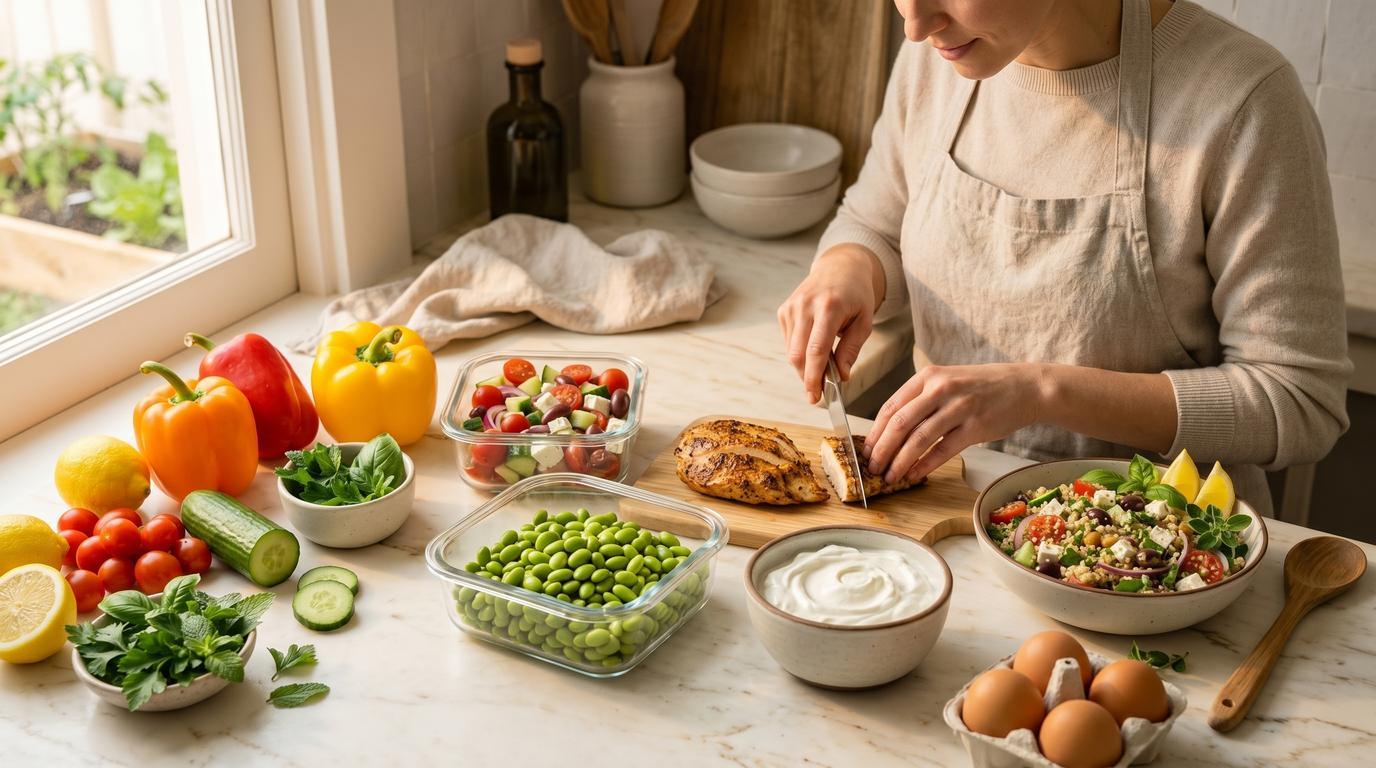
High-protein foods that work well in smaller-volume meals:
- Greek yogurt (plain, full-fat): 17-20 grams of protein per cup
- Eggs: 6 grams each; 3 eggs = 18 grams
- Chicken breast: 26 grams per 3-ounce serving
- Cottage cheese: 14 grams per half cup
- Salmon or tuna: 22-25 grams per 3-ounce serving
- Edamame: 17 grams per cup
- Lentils: 18 grams per cooked cup
- Tofu: 10 grams per half cup (firm)
- Whey or casein protein powder: 20-25 grams per scoop
---
Practical Strategies for Hitting Your Protein Goals
Prioritize protein first at every meal. Eat the protein on your plate before anything else. On GLP-1 medications, you often reach fullness quickly, and filling up on rice, bread, or salad before getting to the chicken leaves you short on protein.
Track your intake for the first few weeks. Most people dramatically underestimate how much protein they eat. A week of tracking using a food app often reveals a significant gap between what someone thinks they eat and what they actually consume. Once you calibrate your sense of portions, you can track less obsessively.
Keep high-protein foods accessible. Hard-boiled eggs in the fridge, Greek yogurt in portioned containers, protein bars you actually like, and rotisserie chicken from the grocery store are practical solutions for days when cooking feels like too much.
Use protein shakes strategically. When appetite suppression makes eating feel difficult, a protein shake bypasses the psychological friction of sitting down to a meal. Keep this as one tool, not the only tool, but it is particularly useful during the first several weeks of dose titration.
Do not skip meals to create more deficit. This is a common mistake. On a GLP-1, your appetite is already suppressed. Skipping meals may feel easy but it compounds the lean mass risk by reducing the amino acid supply your muscle needs. Eat something, even if it is small, and make sure that something contains protein.
---
What About Protein Quality?
Not all protein is equivalent. The body uses protein differently depending on its amino acid composition, and specifically the content of essential amino acids (EAAs) that the body cannot make on its own.
Animal proteins, including meat, fish, eggs, and dairy, are considered complete proteins because they contain all essential amino acids in proportions that closely match human needs. Plant proteins, with some exceptions like soy and quinoa, are either incomplete or have lower concentrations of specific EAAs like leucine, which is particularly important for stimulating muscle protein synthesis.
This does not mean plant-based eaters cannot preserve muscle during GLP-1 therapy. It means they need to be more intentional about combining protein sources to ensure adequate EAA coverage. Pairing legumes with whole grains, incorporating soy-based proteins like tempeh and edamame, and potentially supplementing with plant-based protein powder are useful strategies.
If you eat animal protein, diversifying your sources (poultry, fish, dairy, eggs) gives you variety while consistently hitting EAA targets. Fatty fish like salmon also provides omega-3 fatty acids, which have their own emerging evidence for supporting muscle protein synthesis.
---
Protein and Resistance Training Work Together
Protein alone is not the complete answer. The LEAN-PREP trial tests protein supplementation in combination with resistance exercise, not protein alone, because [resistance training](/resources/exercise-on-glp1-medications) provides the stimulus that tells your body to keep the muscle it has. [4]
The European Heart Journal review specifically calls out resistance training as "the suggested strategy for preserving skeletal muscle and functional capacity during pharmacologic weight loss," with protein optimization listed as an adjunctive intervention. [2]
You do not need to become a competitive lifter. Two to three sessions per week of resistance training, including exercises targeting major muscle groups, is sufficient to create the anabolic signal that drives muscle protein synthesis. Bodyweight exercises, resistance bands, or free weights all accomplish this.
The combination of adequate protein and resistance training is substantially more effective than either alone. Protein provides the raw material; resistance training tells your body to use it to build and maintain muscle rather than burn it for energy.
---
Realistic Expectations
Protein and exercise can meaningfully reduce lean mass loss during GLP-1 therapy. They do not eliminate it. Some lean mass loss is an expected consequence of caloric restriction at any meaningful rate. The goal is to minimize it, preserve physical function, and keep your metabolism running as efficiently as possible through the weight loss phase.
The clinical evidence is clear that GLP-1 medications produce weight loss, and that a significant portion of that weight loss is lean mass in most people who do not actively intervene. The good news is that intervention is available, practical, and has a strong evidence base. Hitting your protein targets and maintaining resistance training are not complicated behaviors. They do require intention, especially when your appetite is suppressed and food feels less interesting than usual.
Speak with your provider about protein goals specific to your body weight, health status, and how your treatment is progressing. These targets are general guidance; individual needs vary based on age, kidney function, activity level, and the pace of your weight loss.
---
The Bottom Line
On GLP-1 medications, aiming for 1.2 to 1.6 grams of protein per kilogram of body weight per day is supported by current research for lean mass preservation. Spread that protein across three to four meals of 25 to 40 grams each, prioritize protein first at every eating occasion, and pair your nutrition strategy with consistent [resistance training](/resources/exercise-on-glp1-medications). These behaviors give your muscle the best possible chance of surviving the weight loss process intact.
Ready to explore your options? [Check your eligibility](/quiz) for a Prescriva medically supervised weight management program.
---
*This is not medical advice. Consult your licensed healthcare provider before starting any medication, supplement, or nutrition program. Compounded semaglutide and tirzepatide are not FDA-approved. Individual results vary. Prescriva LLC is a management services organization and does not practice medicine or make clinical decisions.*
---
References
- Batsis JA, Gavras A, Gross DC, et al. Effect of Incretin-Based and Nonpharmacologic Weight Loss on Body Composition: A Systematic Review. Ann Intern Med. 2026 Apr 17. doi:10.7326/ANNALS-25-00478. PMID [41996180](https://pubmed.ncbi.nlm.nih.gov/41996180/).
- Khan MS, Dawood MH, Handelsman Y, et al. Fat, muscle, and anti-obesity medications in cardiovascular disease prevention. Eur Heart J. 2026 Mar 31. doi:10.1093/eurheartj/ehag201. PMID [41914150](https://pubmed.ncbi.nlm.nih.gov/41914150/).
- Gwin JA, Church DD, Wolfe RR, Ferrando AA, Pasiakos SM. Muscle Protein Synthesis and Whole-Body Protein Turnover Responses to Ingesting Essential Amino Acids, Intact Protein, and Protein-Containing Mixed Meals with Considerations for Energy Deficit. Nutrients. 2020 Aug 15;12(8):2457. doi:10.3390/nu12082457. PMID [32824200](https://pubmed.ncbi.nlm.nih.gov/32824200/).
- Alawadhi AA, Alroudhan D, Alsaeed DJ, et al. LEAN mass Preservation with Resistance Exercise and Protein during semaglutide and tirzepatide therapy (LEAN-PREP study): a protocol for a randomised controlled trial. BMJ Open. 2026 Apr 22;16(4):e116911. doi:10.1136/bmjopen-2026-116911. PMID [42020128](https://pubmed.ncbi.nlm.nih.gov/42020128/).
- Beavers KM, Nesbit BA, Kiel JR, et al. Effect of an Energy-Restricted, Nutritionally Complete, Higher Protein Meal Plan on Body Composition and Mobility in Older Adults With Obesity: A Randomized Controlled Trial. J Gerontol A Biol Sci Med Sci. 2019 May 16;74(6):929-935. doi:10.1093/gerona/gly146. PMID [30629126](https://pubmed.ncbi.nlm.nih.gov/30629126/).
Stay informed
Weekly research updates and health guides. No spam.
References
- Batsis JA, Gavras A, Gross DC, et al. Effect of Incretin-Based and Nonpharmacologic Weight Loss on Body Composition: A Systematic Review. Ann Intern Med. 2026 Apr 17. doi:10.7326/ANNALS-25-00478. PMID 41996180.. Published Research (2026).
- Khan MS, Dawood MH, Handelsman Y, et al. Fat, muscle, and anti-obesity medications in cardiovascular disease prevention. Eur Heart J. 2026 Mar 31. doi:10.1093/eurheartj/ehag201. PMID 41914150.. Published Research (2026).
- Gwin JA, Church DD, Wolfe RR, Ferrando AA, Pasiakos SM. Muscle Protein Synthesis and Whole-Body Protein Turnover Responses to Ingesting Essential Amino Acids, Intact Protein, and Protein-Containing Mixed Meals with Considerations for Energy Deficit. Nutrients. 2020 Aug 15;12(8):2457. doi:10.3390/nu12082457. PMID 32824200.. Published Research (2020).
- Alawadhi AA, Alroudhan D, Alsaeed DJ, et al. LEAN mass Preservation with Resistance Exercise and Protein during semaglutide and tirzepatide therapy (LEAN-PREP study): a protocol for a randomised controlled trial. BMJ Open. 2026 Apr 22;16(4):e116911. doi:10.1136/bmjopen-2026-116911. PMID 42020128.. Published Research (2026).
- Beavers KM, Nesbit BA, Kiel JR, et al. Effect of an Energy-Restricted, Nutritionally Complete, Higher Protein Meal Plan on Body Composition and Mobility in Older Adults With Obesity: A Randomized Controlled Trial. J Gerontol A Biol Sci Med Sci. 2019 May 16;74(6):929-935. doi:10.1093/gerona/gly146. PMID 30629126.. Published Research (2019).
Ready to get started?
Check if you qualify for a personalized treatment plan.
Check Your Eligibility →Continue reading
GLP-1 Medications After Bariatric Surgery: What the Research Shows About Weight Regain
Tirzepatide and Birth Control: What You Need to Know About Oral Contraceptives