What to Do If You Miss a Dose of Semaglutide or Tirzepatide
The missed-dose semaglutide and tirzepatide protocol is one of the most practical pieces of knowledge for anyone on weekly GLP-1 therapy: here is exactly what to do when real life gets in the way of y
In this article
The missed-dose semaglutide and tirzepatide protocol is one of the most practical pieces of knowledge for anyone on weekly GLP-1 therapy: here is exactly what to do when real life gets in the way of your injection schedule.
*Compounded semaglutide and [compounded tirzepatide](/resources/compounded-tirzepatide-guide) are not FDA-approved medications. This article is for informational purposes only and does not constitute medical advice. Dosing guidance for compounded medications may vary from FDA-labeled products. Always follow the instructions provided by your prescribing provider. Individual results vary. Care at Prescriva is delivered by independently licensed providers, not by Prescriva LLC, which is a management services organization.*
---
It happens to nearly everyone on a weekly injectable medication at some point. You planned to inject on Sunday, but Sunday came and went between a long drive, a family dinner, and a schedule that got away from you. Now it is Tuesday, or maybe Thursday, and you are staring at your pen wondering: do I take it now, skip it, or call someone?
GLP-1 receptor agonist medications like [compounded semaglutide](/resources/compounded-semaglutide-what-it-is) and compounded tirzepatide are dosed once weekly for a specific pharmacological reason. Their extended half-lives are designed to maintain consistent, stable drug levels over seven days. But missing a dose does not automatically erase your progress or create a medical crisis. There is a clear and safe path forward, and it depends mainly on one thing: how long it has been since the missed injection.
This guide explains exactly what to do, why the timing windows exist, and how to stay on track when real life gets in the way.
---
Why GLP-1 Medications Are Dosed Weekly
To understand the missed-dose rules, it helps to understand why the medications are designed for once-weekly dosing in the first place.
Semaglutide achieves its once-weekly profile through a process called lipidation: the molecule is chemically attached to a fatty acid chain that allows it to bind reversibly to serum albumin, a protein naturally circulating in the blood. This albumin binding significantly extends the drug's half-life to approximately seven days. [1] Without this modification, GLP-1's natural half-life would be measured in minutes.
Because of this extended half-life, active semaglutide remains in your body for two to three weeks after a single injection, gradually diminishing. A single missed dose creates a temporary dip in active drug levels, not an abrupt stop. The key concern when missing a dose is avoiding situations where doses are taken too closely together, which can intensify gastrointestinal [side effects](/resources/semaglutide-side-effects-what-to-expect) like nausea and vomiting.
Tirzepatide, which activates both GLP-1 and GIP receptors, has a comparable pharmacokinetic profile and is also designed for once-weekly administration.
---
Semaglutide Missed Dose: The 5-Day Rule
For subcutaneous semaglutide (compounded semaglutide, once weekly):
If fewer than 5 days (120 hours) have passed
Take your dose as soon as you remember. Then return to your regular weekly schedule, based on the original day you normally inject. Do not take two doses within 48 hours of each other.
If 5 days or more have passed
Skip the missed dose entirely. Do not double up. Simply take your next dose on your regular scheduled day.
Practical example: Your normal injection day is Sunday. You forget. On Wednesday (three days later), you remember. Wednesday is within the five-day window, so take the dose then, and resume your normal Sunday schedule the following week.
If you do not remember until Saturday, that is six days after Sunday. At that point, skip Saturday and take your next scheduled Sunday dose as usual.
---
Tirzepatide Missed Dose: The 4-Day Rule
For subcutaneous tirzepatide (compounded tirzepatide, once weekly):
If fewer than 4 days (96 hours) have passed
Take your dose as soon as you remember, then return to your regular weekly schedule.
If 4 days or more have passed
Skip the missed dose and resume on your next regular injection day. Do not take two doses within 72 hours.
The window for tirzepatide is slightly shorter than for semaglutide. The logic is the same: you want to maintain consistent levels without creating a situation where doses are compressed too closely, which dramatically increases the risk of gastrointestinal side effects.
If you find yourself regularly approaching the four-day cutoff, that is a sign your current injection day may not be the right fit for your schedule. Switching to a day that is more reliably clear in your week is a simple fix worth discussing with your provider.
---
What If You Miss Multiple Doses in a Row?
Missing a single dose and following the guidelines above is straightforward. Missing two or more consecutive weeks is a different situation that warrants a conversation with your provider before you resume.
After a gap of two or more weeks without your GLP-1 medication, your physiological tolerance to the drug has decreased. The gradual dose titration you went through when you first started treatment, moving up slowly from the lowest dose, served a specific purpose: allowing your gastrointestinal system to adapt. After a significant break, that adaptation partially reverses.
Jumping back to your current maintenance dose after a two-week gap often causes the same nausea, vomiting, and discomfort that some people experienced in the early weeks of treatment. Most providers will recommend stepping back down to a lower dose for a few weeks before returning to your maintenance level. This is not starting over; it is a brief recalibration to avoid a rough restart.
Contact your prescribing provider if you have missed two or more doses in a row. They can advise on whether you need to re-titrate and at what dose to resume.
---
Does Missing a Dose Affect Your Weight Loss Progress?
In the short term, one missed dose is unlikely to produce noticeable changes in your weight or appetite. Because semaglutide has a half-life of approximately seven days, residual medication continues to circulate in your system for weeks after any given injection. One skipped week means a modest, temporary dip in active drug levels, not a full interruption of the medication's effects.
Over the longer term, however, consistent dosing is the foundation of effective GLP-1 therapy. The STEP 4 randomized clinical trial examined this directly. After 20 weeks of semaglutide treatment, participants were either continued on semaglutide or switched to placebo for an additional 48 weeks. Those who continued the medication lost an additional 7.9% of body weight. Those switched to placebo gained back 6.9%. The difference between continuation and discontinuation was nearly 15 percentage points over less than a year. [2]
The STEP 1 trial extension reinforced the message about long-term interruption. One year after stopping semaglutide entirely, participants regained approximately two-thirds of the weight they had lost, with similar reversal of the cardiometabolic improvements they had gained. [3] The medications produce their results during active use. Extended gaps without doses are not neutral events.
---
How to Prevent Missed Doses
The most effective approach to missed doses is removing the conditions that cause them in the first place. A few practical strategies:
Anchor your injection to a weekly routine. Sunday evening after dinner. Friday morning before coffee. Monday night when the kids are in bed. The key is connecting the injection to something that already happens reliably every week. It becomes automatic rather than a separate item to remember.
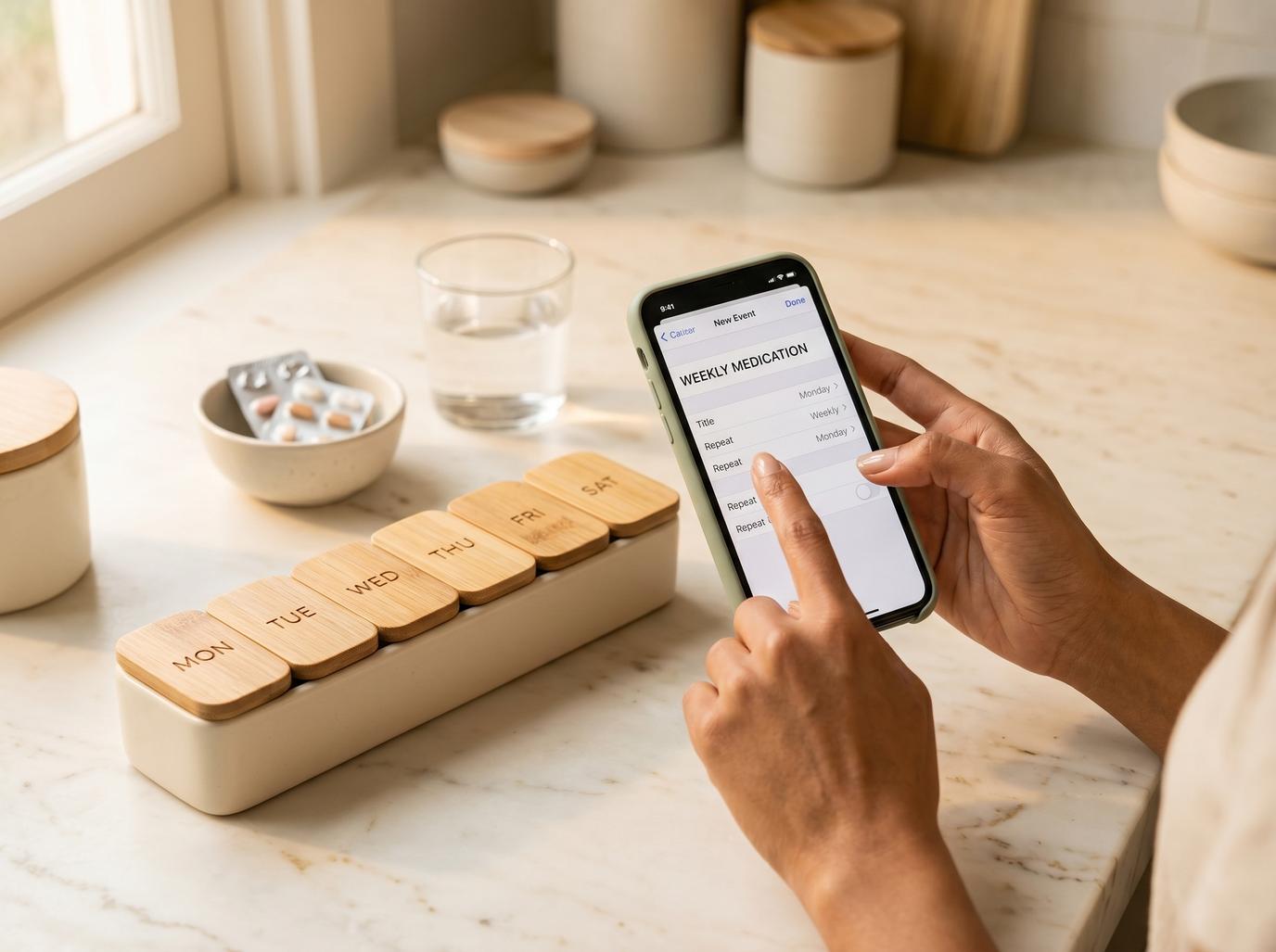
Set a recurring phone alarm. This is the simplest and most reliable reminder system. A weekly alarm on your phone, set to your injection day and time, takes about 30 seconds to configure and significantly reduces the chance of forgetting.
Keep your medication in a visible spot. If your pen is stored on a dedicated spot on the refrigerator door shelf, it serves as a daily visual cue. If it is buried in a drawer, it does not.
Build in a backup. Some people set a reminder on the night before their injection day as a secondary prompt. If you miss the primary cue, you still have the next morning.
Plan around travel. If you are traveling, think about your injection schedule before you leave. Compounded semaglutide and tirzepatide require refrigeration during storage but can tolerate room temperature for limited periods during active use. A medication travel cooler handles most trip scenarios. TSA guidelines allow injectable medications in carry-on bags with appropriate documentation.
Inject early when you know a conflict is coming. If your normal injection day is Sunday and you have a busy trip starting that day, injecting on Friday or Saturday of that week is generally fine. Just ensure there are at least 48 hours (semaglutide) or 72 hours (tirzepatide) between doses. Confirm with your provider if you are not sure.
---
When to Contact Your Provider
Most missed-dose situations resolve by following the guidelines above and do not require a provider call. Reach out to your prescribing provider if:
- You have missed two or more consecutive weekly doses
- You are resuming after a gap of more than two weeks and want guidance on re-titration
- You experience significant nausea, vomiting, or other side effects when resuming after a gap
- Your injection pen malfunctioned and you are not sure whether the dose was delivered
- You recently started a new medication and are uncertain about interactions
- You have any symptoms that feel concerning after a dose
---
Frequently Asked Questions
Can I take my dose a day early to avoid a scheduling conflict?
Yes. Taking your dose one or two days earlier in a given week is generally fine. Just resume your normal injection day the following week. Do not compress doses by more than two days in either direction without checking with your provider.
What if I accidentally injected twice in the same week?
Contact your provider. A double dose is not typically a medical emergency, but it is likely to cause significant gastrointestinal discomfort, and your provider should be informed. Do not take your next scheduled dose within the normal window if you have accidentally doubled up; allow extra time between doses and follow provider guidance.
Will I feel nausea again after missing one dose?
After a single missed dose, probably not. Residual medication in your system means your tolerance level has not meaningfully reset. After two or more missed weeks, some people do experience a return of mild nausea when resuming, which is why re-titration may be recommended in those cases.
Does it matter what time of day I inject?
GLP-1 medications are designed to be taken on the same day each week, not necessarily the same time of day. Consistency in day of the week is more important than hour. Once you have established your injection day, the exact time within that day is flexible.
Can I store my pen outside the refrigerator when traveling?
Compounded semaglutide and tirzepatide are stable at room temperature (below 77F / 25C) for a limited period during active use. For travel lasting more than a few days, using a small cooler or insulated medication case is the most reliable way to maintain appropriate storage conditions. Confirm storage requirements and any travel-specific guidance with your prescribing provider or pharmacy.
---
*This article is not a substitute for guidance from your licensed prescribing provider. Dosing rules for compounded semaglutide and tirzepatide may differ from those for FDA-approved branded formulations. Always follow your provider's specific instructions.*
---
Still Getting Started?
If you are exploring whether a GLP-1 weight loss program is right for you, our licensed providers can walk you through eligibility, what to expect, and how the process works.
[Check Your Eligibility](https://prescriva.com/start)
---
References
- Hall S, et al. Pharmacokinetics and Clinical Implications of Semaglutide: A New Glucagon-Like Peptide (GLP)-1 Receptor Agonist. Clin Pharmacokinet. 2018;57(11):1329-1338. PMID [29915923](https://pubmed.ncbi.nlm.nih.gov/29915923/).
- Rubino DM, et al. Effect of Continued Weekly Subcutaneous Semaglutide vs Placebo on Weight Loss Maintenance in Adults With Overweight or Obesity: The STEP 4 Randomized Clinical Trial. JAMA. 2021;325(14):1414-1425. PMID [33755728](https://pubmed.ncbi.nlm.nih.gov/33755728/).
- Wilding JPH, et al. Weight Regain and Cardiometabolic Effects After Withdrawal of Semaglutide: The STEP 1 Trial Extension. Diabetes Obes Metab. 2022;24(8):1553-1564. PMID [35441470](https://pubmed.ncbi.nlm.nih.gov/35441470/).
Stay informed
Weekly research updates and health guides. No spam.
References
- Hall S, et al. Pharmacokinetics and Clinical Implications of Semaglutide: A New Glucagon-Like Peptide (GLP)-1 Receptor Agonist. Clin Pharmacokinet. 2018;57(11):1329-1338. PMID 29915923.. Published Research (2018).
- Rubino DM, et al. Effect of Continued Weekly Subcutaneous Semaglutide vs Placebo on Weight Loss Maintenance in Adults With Overweight or Obesity: The STEP 4 Randomized Clinical Trial. JAMA. 2021;325(14):1414-1425. PMID 33755728.. Published Research (2021).
- Wilding JPH, et al. Weight Regain and Cardiometabolic Effects After Withdrawal of Semaglutide: The STEP 1 Trial Extension. Diabetes Obes Metab. 2022;24(8):1553-1564. PMID 35441470.. Published Research (2022).
Ready to get started?
Check if you qualify for a personalized treatment plan.
Check Your Eligibility →Continue reading

GLP-1 Medications After Bariatric Surgery: What the Research Shows About Weight Regain

Tirzepatide and Birth Control: What You Need to Know About Oral Contraceptives