How to Inject Tirzepatide: A Step-by-Step Guide for First-Timers
The first time you inject yourself feels like a bigger deal than it actually is. Most people spend more time preparing mentally than they do performing the actual injection. Once you have done it once
In this article
The first time you inject yourself feels like a bigger deal than it actually is. Most people spend more time preparing mentally than they do performing the actual injection. Once you have done it once or twice, the response is almost always the same: "That was it?"
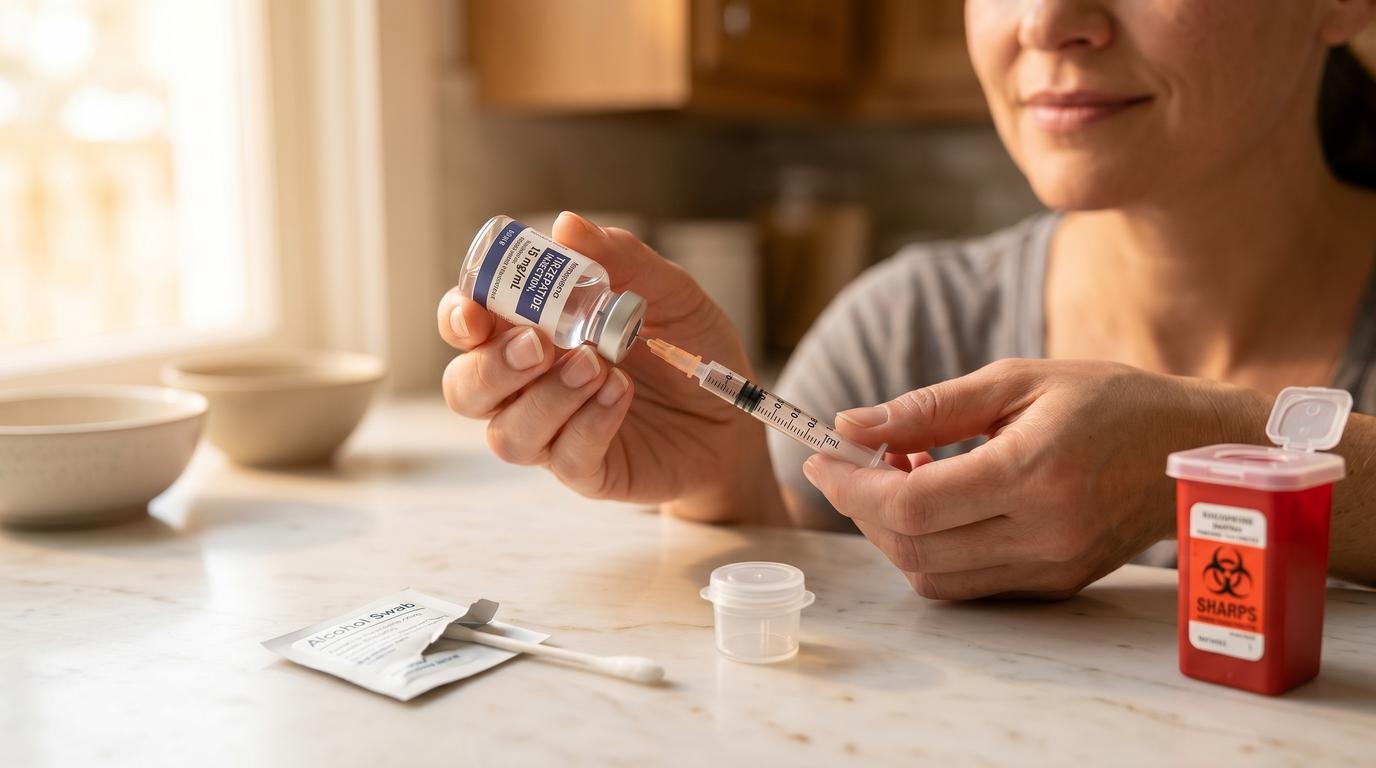
This guide walks you through everything you need to know about injecting tirzepatide at home. For semaglutide injection instructions, see [how to inject semaglutide](/resources/how-to-inject-semaglutide). If you are using compounded tirzepatide (the most common format through telehealth programs), you have a multi-dose vial and insulin syringes, not an autoinjector pen. Learn more about [how tirzepatide works](/resources/how-does-tirzepatide-work). The steps below cover that vial-and-syringe method specifically.
*Compounded tirzepatide is not FDA-approved. This article is for informational purposes only and does not constitute medical advice. Always follow the specific instructions provided by your prescribing healthcare provider and pharmacist.*
---
What You Will Need
Compounded tirzepatide is dispensed as a multi-dose vial with separate insulin syringes. This is different from the prefilled autoinjector pens used for brand-name products like Mounjaro or Zepbound. Gather everything before you begin:
For vial-based compounded tirzepatide:
- Your tirzepatide vial (kept refrigerated until 30 minutes before use)
- Insulin syringes (your provider will specify gauge and needle length; 31-gauge, 4mm or 6mm needles are common)
- Alcohol swabs (at least two)
- An FDA-cleared sharps disposal container
- A clean, well-lit surface
- Gauze or a cotton ball
- A bandage (minor bleeding at the injection site is normal and harmless)
---
Choosing Your Injection Site
Tirzepatide is a subcutaneous injection. It goes into the fatty layer just beneath the skin, not into muscle or a vein. Three body areas are recommended for subcutaneous self-injection:
Abdomen (most commonly used) The area at least two inches away from your navel on either side. The abdomen offers the most surface area for rotation and is generally the most accessible site for self-injection. Avoid the area directly around your belly button.
Outer thigh The front-outer portion of your upper thigh, roughly the middle third between your knee and hip. Easy to see and reach, and a practical option if you prefer it over the abdomen.
Upper arm The back of the upper arm, mid-region. This site is commonly used for provider-administered injections. Self-injection here requires some flexibility to reach comfortably, but it is possible with practice.
All three sites deliver the medication effectively. Choose the one that is most comfortable and accessible for you. Your provider may have a recommendation based on your body composition.

---
Step-by-Step Injection Instructions
Read through all the steps once before you start. The full process takes under two minutes once you are familiar with it.
Step 1: Wash Your Hands
Wash your hands thoroughly with soap and water for at least 20 seconds. Dry them completely before handling any supplies.
Step 2: Prepare Your Medication
Remove the tirzepatide vial from the refrigerator about 30 minutes before injecting. Room-temperature medication is more comfortable than cold medication. Do not warm the vial in a microwave or warm water.
Inspect the medication visually. It should be clear and colorless or very slightly yellow, with no visible particles. If the solution looks cloudy, discolored, or contains floating matter, do not use it. Contact your pharmacy.
Your formulation is typically a clear solution. Do not shake the vial.
Step 3: Draw Up the Dose
Wipe the rubber stopper on the top of the vial with a fresh alcohol swab and let it air dry for a few seconds.
Remove the cap from the syringe and draw back the plunger to fill the syringe with air equal to your prescribed dose volume. Insert the needle through the rubber stopper and push the air into the vial. This equalizes pressure and makes drawing up the medication easier.
Invert the vial so the needle points upward. Slowly pull the plunger back to draw the medication. Pull slightly past your prescribed volume, then gently push the plunger forward to release any air bubbles and arrive at the exact dose. Withdraw the needle from the vial.
Do not recap the syringe after this point.
Step 4: Prepare the Injection Site
Select your site for this week. Clean the skin with a fresh alcohol swab using a small circular motion. Let the area air dry completely before injecting. Injecting through wet alcohol can sting and may increase irritation.
Step 5: Inject
Use the angle and technique your provider or pharmacist specified for your needle length. For shorter 4mm to 6mm needles, a 90-degree angle is standard (with a gentle skin pinch for 6mm needles). For longer 8mm or larger needles, a 45-degree angle with a pinched skin fold is recommended to avoid injecting into muscle. The needle should enter smoothly with minimal resistance.
Release the pinch if you are using one. Slowly and steadily depress the plunger all the way down. Do not rush this step.
Once the full dose is delivered, hold the needle in place for five seconds before withdrawing. This small pause reduces the chance of medication tracking back along the needle path.
Withdraw the needle at the same angle it was inserted. Do not rub the injection site after removal.
Step 6: Dispose of the Needle Safely
Place the used syringe directly into your sharps container immediately after withdrawal. Never recap a used needle, and never place used syringes in regular household trash or recycling.
When your sharps container is full, follow your local guidelines for disposal. Many pharmacies accept sealed, full sharps containers.
---
Rotating Injection Sites
Using the same spot repeatedly causes the fatty tissue beneath the skin to thicken over time, a condition called lipohypertrophy. Injecting into thickened tissue can affect how reliably the medication absorbs, and the area may feel lumpy or hard.
Rotate your injection site with each weekly dose. A simple method: divide your preferred area into a grid of small zones roughly one inch apart, and move to a new zone each week. Many people track this with a simple note on their phone or a small calendar.
If you use both sides of the abdomen, alternate left and right as well as cycling through zones on each side.
---
Compounded Tirzepatide vs. Branded Autoinjector Pens
If you have seen or used brand-name Mounjaro or Zepbound autoinjector pens, the vial-and-syringe approach for compounded tirzepatide will feel different. The key practical differences:
| Feature | Compounded Vial + Syringe | Branded Autoinjector Pen |
|---|---|---|
| Dose setup | Manual draw | Pre-set dial |
| Needle visibility | Full | Hidden or minimal |
| Steps involved | More | Fewer |
| Concentration | Varies by pharmacy | Fixed per product |
| Cost | Generally lower | Higher |
---
Storage and Handling
Before opening: Store your tirzepatide vial in the refrigerator at 36°F to 46°F (2°C to 8°C). Do not freeze. Keep it away from direct light and heat.
After opening: Most compounded tirzepatide vials can be stored in the refrigerator for 28 to 56 days after first use, depending on the formulation and pharmacy. Your pharmacy label specifies the beyond-use date. Follow it exactly.
At room temperature: Brief periods at room temperature (under 77°F) are acceptable for the 30 minutes before each injection. Do not leave your vial unrefrigerated for extended periods.
Traveling: A soft-sided cooler with an ice pack works well for short trips. For longer travel, a dedicated medication travel case with temperature control is worth using. Keep the vial out of direct sunlight and away from hot car interiors.
Before each use: Inspect the medication as described in step 2. Discard any vial that shows changes in appearance or that has passed its beyond-use date.
---
What to Do If You Miss a Dose
Tirzepatide is a once-weekly injection. If you miss your scheduled day:
- If fewer than five days have passed since your scheduled dose, take the missed dose as soon as you remember.
- If five or more days have passed, skip the missed dose and resume your regular weekly schedule on the next planned dose day.
- Do not take two doses in the same week to make up for a missed one.
---
Common Injection Concerns
Bruising at the site Minor bruising after subcutaneous injection is normal and typically fades within a few days. It often occurs when the needle nicks a small vessel in the subcutaneous layer. Rotating sites and varying the exact spot within a zone reduces how often this happens.
A small lump or raised area under the skin A small raised area immediately after injection is normal and usually disappears within an hour or so. Persistent lumps or firm areas that do not resolve over days may indicate lipohypertrophy from repeated injection in the same spot. Move to a new area and mention it to your provider.
Stinging or burning during injection Stinging is most commonly caused by injecting before the alcohol has fully dried, by using cold medication, or by pushing the plunger too quickly. Let the site dry completely, bring the vial to room temperature, and inject slowly.
Bleeding after the needle is removed A small drop of blood at the injection site is normal. Apply gentle pressure with a cotton ball or gauze for about 30 seconds. If bleeding persists beyond that, contact your provider.
You are not sure the full dose went in If you pushed the plunger fully and nothing obviously leaked back out, you most likely delivered the full dose. If you noticed significant leakage or cannot confirm the dose was complete, do not inject an additional dose to compensate. Note the situation and contact your provider.
---
Frequently Asked Questions
Can I inject tirzepatide anywhere on my body? Stay with the three recommended sites: abdomen, outer thigh, or upper arm. These areas have adequate subcutaneous fat and are consistent with how tirzepatide has been used clinically. Avoid areas with skin conditions, scars, stretch marks, or known lipohypertrophy.
Does the time of day matter? No. Tirzepatide is dosed once weekly, and the time of day does not meaningfully affect how it works. Choose a consistent day that fits your schedule. Some people prefer injecting in the evening to sleep through any transient nausea, though this is a personal preference.
Can I inject through clothing? Avoid this. Injecting through clothing skips the cleaning step and introduces contamination risk. Always inject into exposed, freshly cleaned skin.
What if there is an air bubble in the syringe? Small air bubbles in a subcutaneous syringe are not dangerous the way they would be in an intravenous setting. That said, it is good practice to remove visible bubbles before injecting: tap the syringe gently with your finger and slowly push the plunger until the bubble exits the needle tip.
My injection site is red and warm. Should I be concerned? Some minor redness immediately after injection is normal and usually fades within an hour. Redness, warmth, swelling, or pain that spreads or persists beyond 24 to 48 hours can indicate an infection. Contact your provider if you notice these signs.
When should I call my provider? Contact your provider for significant or worsening pain, spreading redness or swelling, drainage from the injection site, or any side effect that concerns you. Also reach out if you have questions about your specific dose, concentration, or injection technique.
---
Self-injection is a learned skill, and some nervousness at the start is normal. Most people settle into a comfortable routine within a few weeks. The goal is a clean, confident technique you can repeat every week without second-guessing it.
If your provider or pharmacist gave you instructions that differ from anything in this guide, follow their instructions. They know your specific formulation, dose, and health history.
---
*This content is for educational purposes only and does not constitute medical advice. Compounded tirzepatide is not FDA-approved and has not been reviewed by the FDA for safety, efficacy, or quality. Compounded tirzepatide is not the same as, equivalent to, or interchangeable with brand-name Mounjaro or Zepbound. Always follow the instructions of your licensed healthcare provider and pharmacist. Individual results vary.*
*All medical services, including prescribing and injection technique guidance, are provided by independently licensed healthcare providers. Prescriva LLC is a management services organization and does not practice medicine or make clinical decisions.*
*Mounjaro and Zepbound are registered trademarks of Eli Lilly and Company. Prescriva is not affiliated with, endorsed by, or sponsored by Eli Lilly.*
---
References
- Jastreboff AM, et al. "Tirzepatide Once Weekly for the Treatment of Obesity." *N Engl J Med.* 2022;387(3):205-216. PMID: 35658024.
- Rosenstock J, et al. "Efficacy and safety of a novel dual GIP and GLP-1 receptor agonist tirzepatide in patients with type 2 diabetes (SURPASS-1)." *Lancet.* 2021;398(10295):143-155. PMID: 34186022.
- Frías JP, et al. "Tirzepatide versus Semaglutide Once Weekly in Patients with Type 2 Diabetes." *N Engl J Med.* 2021;385(6):503-515. PMID: 34170647.
- FDA. "Mounjaro (tirzepatide) Prescribing Information." NDA 215866. Available at: fda.gov.
- FDA. "Zepbound (tirzepatide) Prescribing Information." NDA 217806. Available at: fda.gov.
Stay informed
Weekly research updates and health guides. No spam.
References
- Jastreboff AM, et al. "Tirzepatide Once Weekly for the Treatment of Obesity." *N Engl J Med.* 2022;387(3):205-216. PMID: 35658024.. Published Research (2022).
- Rosenstock J, et al. "Efficacy and safety of a novel dual GIP and GLP-1 receptor agonist tirzepatide in patients with type 2 diabetes (SURPASS-1)." *Lancet.* 2021;398(10295):143-155. PMID: 34186022.. Published Research (2021).
- Frías JP, et al. "Tirzepatide versus Semaglutide Once Weekly in Patients with Type 2 Diabetes." *N Engl J Med.* 2021;385(6):503-515. PMID: 34170647.. Published Research (2021).
- FDA. "Mounjaro (tirzepatide) Prescribing Information." NDA 215866. Available at: fda.gov.. Published Research (2024).
- FDA. "Zepbound (tirzepatide) Prescribing Information." NDA 217806. Available at: fda.gov.. Published Research (2024).
Ready to get started?
Check if you qualify for a personalized treatment plan.
Check Your Eligibility →Continue reading

GLP-1 Medications After Bariatric Surgery: What the Research Shows About Weight Regain

Tirzepatide and Birth Control: What You Need to Know About Oral Contraceptives