GLP-1 Medications and ADHD: What the Research Says About Dopamine and Focus
The relationship between semaglutide and ADHD is an emerging research area, with early evidence suggesting GLP-1 receptor agonists may influence the dopamine pathways that underlie attention and impul

In this article
The relationship between semaglutide and ADHD is an emerging research area, with early evidence suggesting GLP-1 receptor agonists may influence the dopamine pathways that underlie attention and impulse control.
*Compounded semaglutide is not FDA-approved and is not approved or indicated for the treatment of ADHD. This article is for educational and informational purposes only and does not constitute medical advice. Clinical data referenced here reflects studies of FDA-approved pharmaceutical compounds and published research unless otherwise noted. Individual results vary. Consult your licensed healthcare provider before starting, stopping, or adjusting any medication. Care at Prescriva is delivered by independently licensed providers, not by Prescriva LLC, which is a management services organization.*
---
ADHD and obesity are more connected than most people realize. They are not simply two separate conditions that happen to appear together. Research points to shared biology, shared brain circuits, and a shared core mechanism: dopamine dysregulation.
That overlap has researchers asking a new question. GLP-1 receptor agonists, now widely used for medically supervised weight management, work in part by influencing reward-related brain pathways. Could those same pathways, which are also disrupted in ADHD, explain some of what patients with both conditions report when they start a GLP-1 program?
This article is not an argument that GLP-1 medications treat ADHD. They are not approved for that purpose, and no controlled clinical trial has tested that hypothesis directly. What exists right now is early, preliminary, and mostly observational. But the neurological overlap is real, and people managing both conditions deserve a clear-eyed look at what the science shows.
---
ADHD and Obesity: A Closer Look at the Connection
ADHD is more common than most people realize. Among adults, prevalence estimates typically range from 3 to 5 percent. But when you look specifically at people seeking treatment for obesity, that number climbs substantially.
A systematic review in *Postgraduate Medicine* found that ADHD appeared at significantly higher rates in clinical populations seeking obesity treatment compared to the general population (PMID [20861592](https://pubmed.ncbi.nlm.nih.gov/20861592/)). Cortese and colleagues reviewed studies from 1980 to 2010 and found that individuals with ADHD also carried higher-than-average BMI scores. This pattern held across multiple studies and populations.
More recently, a 2025 review in *Nervenarzt* confirmed the pattern, noting a close connection across the lifespan between ADHD and increased risk for cardiometabolic conditions, including obesity (PMID [40298967](https://pubmed.ncbi.nlm.nih.gov/40298967/)). Kittel-Schneider pointed to dopamine metabolism disorders among the key contributing mechanisms alongside genetic factors and inflammatory processes.
The relationship is not simply about hyperactivity or distraction leading to poor dietary choices. It runs deeper than behavior.
---
Dopamine, ADHD, and Reward-Driven Eating
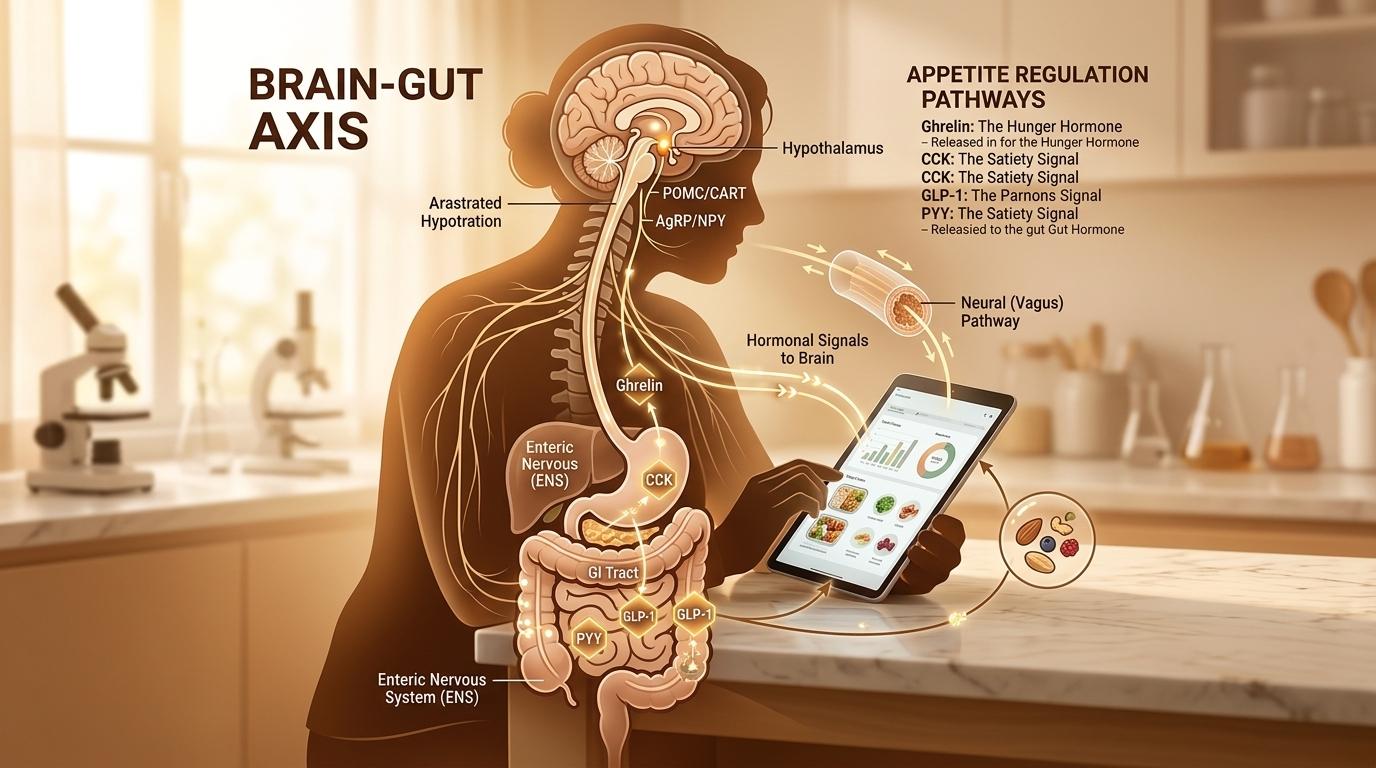
Dopamine is the neurotransmitter most closely associated with reward, motivation, and impulse control. When the dopamine system is functioning well, you can delay gratification, regulate behavior, and feel satisfied with moderate rewards. When it is dysregulated, as is characteristic of ADHD, the brain tends to seek stronger, more immediate stimulation.
This same dopamine deficit model helps explain certain patterns in overeating. High-calorie, highly palatable foods produce fast, strong dopamine responses. For someone whose dopamine system is chronically underactive or poorly regulated, food can serve as a form of self-regulation, providing a quick neurological lift that temporarily improves focus and reduces anxiety.
That is not a personal failing. It is neurobiology. And it is one reason why the ADHD-obesity connection runs so consistently across the research literature.
---
How GLP-1 Receptors Interact With the Dopamine System
GLP-1 receptors are not just found in the gut and pancreas. They are expressed throughout the brain, including in regions central to the dopamine reward circuit: the ventral tegmental area (VTA), the nucleus accumbens, and the prefrontal cortex.
A 2021 systematic review published in *Frontiers in Behavioral Neuroscience* analyzed preclinical and clinical studies on GLP-1 and reward pathways (PMID [33536884](https://pubmed.ncbi.nlm.nih.gov/33536884/)). Eren-Yazicioglu and colleagues found that GLP-1 modulates dopamine levels and glutamatergic neurotransmission in reward-related brain regions. In animal studies, GLP-1 receptor agonists reduced intake of highly palatable foods, alcohol, nicotine, and cocaine. In human studies, GLP-1 altered activity in regions like the insula and orbitofrontal cortex during anticipation and consumption of rewarding foods.
A landmark 2025 paper in *Science* by Zhu and colleagues identified that hedonic eating, the kind driven by pleasure and reward rather than hunger, is controlled by dopamine neurons that directly oppose GLP-1 receptor satiety signaling (PMID [40146831](https://pubmed.ncbi.nlm.nih.gov/40146831/)). This dopamine-GLP-1 interplay helps explain why GLP-1 medications appear to reduce reward-driven eating beyond simply creating a sense of fullness.
A 2026 review in the *International Journal of Molecular Sciences* examined the broader neuropsychiatric implications of GLP-1 and dual GIP/GLP-1 receptor agonists (PMID [42074266](https://pubmed.ncbi.nlm.nih.gov/42074266/)). Tudosie and colleagues noted that GLP-1 receptor activation in key brain regions modulates dopaminergic and serotonergic transmission, influencing behavior, affective processes, and cognitive function. The authors characterized incretin-based therapies as a promising translational approach at the intersection of metabolic and neuropsychiatric conditions.
---
What This May Mean for People With Both Conditions
Some people managing ADHD alongside obesity who start a GLP-1 program report changes that go beyond weight loss. Reduced food preoccupation, less compulsive snacking, a greater ability to pause before reaching for something. These are anecdotal reports, not clinical outcomes from a controlled trial. But they are consistent with what the neurobiological research would predict.
If ADHD involves dopamine dysregulation, and GLP-1 medications modulate dopamine reward circuits, then someone with both conditions might notice effects that extend into attention and impulse-related patterns. The convergence is logical from a neurobiological standpoint.
This is not the same as saying GLP-1 medications improve ADHD. The research does not support that claim. What it suggests is that the brain circuitry underlying reward-driven eating in ADHD may also respond to GLP-1 receptor activation, in ways that early research is only beginning to explore.
For more on how GLP-1 medications affect the brain's appetite signaling systems, see our article on [how semaglutide suppresses appetite](/resources/how-semaglutide-suppresses-appetite). You can also read about [GLP-1 medications and brain health](/resources/glp1-medications-brain-health-cognitive-function) for a broader look at the cognitive research.
---
Important Limitations: What the Research Does Not Show
The current evidence has real limits, and they matter.
There are no randomized controlled trials studying GLP-1 medications specifically in people with ADHD. The dopamine-GLP-1 connection is supported primarily by preclinical animal models and observational data in non-ADHD populations. Human trials showing cognitive or behavioral changes from GLP-1 medications have not used ADHD as a measured outcome.
GLP-1 medications are approved for weight management and type 2 diabetes. They are not approved for ADHD. They are not indicated for ADHD. They should not be used as an ADHD treatment. For people managing ADHD, the appropriate path includes evaluation by a qualified mental health or psychiatric provider and evidence-based ADHD treatment options.
Compounded semaglutide, specifically, is not FDA-approved and has not been studied in any ADHD-specific trials. Any discussion of its potential neurological effects is strictly preliminary and observational.
---
Talk With Your Provider
If you have ADHD and are also managing your weight, this overlap is worth discussing with your healthcare provider. A telehealth provider through Prescriva can evaluate whether a medically supervised weight management program is appropriate for your individual health profile, taking into account your full medical history.
GLP-1 medications for weight management are prescribed based on clinical evaluation, not as a treatment for co-occurring conditions. Understanding how these medications interact with your broader physiology, including your neurological profile, is part of that conversation.
[Start your weight loss assessment at Prescriva](/weight-loss)
---
Key Takeaways
- ADHD and obesity share dopamine dysregulation as a core underlying mechanism, with comorbidity rates significantly higher than general population prevalence (PMID [20861592](https://pubmed.ncbi.nlm.nih.gov/20861592/), PMID [40298967](https://pubmed.ncbi.nlm.nih.gov/40298967/))
- GLP-1 receptors are expressed in dopamine reward regions including the VTA, nucleus accumbens, and prefrontal cortex (PMID [33536884](https://pubmed.ncbi.nlm.nih.gov/33536884/))
- Preclinical and early human research shows GLP-1 medications modulate reward-related dopamine activity and reduce hedonic eating (PMID [40146831](https://pubmed.ncbi.nlm.nih.gov/40146831/), PMID [42074266](https://pubmed.ncbi.nlm.nih.gov/42074266/))
- This research is preliminary and observational: no controlled trial has studied GLP-1 medications specifically for ADHD
- GLP-1 medications are not approved or indicated for ADHD treatment
- Consult a licensed healthcare provider to discuss your individual health profile and treatment options
Sources
- Cortese S, Morcillo Peñalver C. Comorbidity between ADHD and obesity: exploring shared mechanisms and clinical implications. *Postgrad Med.* 2010;122(5):88-96. [PMID: 20861592](https://pubmed.ncbi.nlm.nih.gov/20861592)
- Kittel-Schneider S. Attention deficit/hyperactivity disorder and cardiometabolic diseases: prevalence, etiology and treatment. *Nervenarzt.* 2025;96(3):309-317. [PMID: 40298967](https://pubmed.ncbi.nlm.nih.gov/40298967)
- Eren-Yazicioglu CY, Yigit A, Dogruoz RE, Yapici-Eser H. Can GLP-1 Be a Target for Reward System Related Disorders? A Qualitative Synthesis and Systematic Review Analysis of Studies on Palatable Food, Drugs of Abuse, and Alcohol. *Front Behav Neurosci.* 2021;14:614884. [PMID: 33536884](https://pubmed.ncbi.nlm.nih.gov/33536884)
- Zhu Z, Sternson SM, et al. Hedonic eating is controlled by dopamine neurons that oppose GLP-1R satiety. *Science.* 2025 Mar 28. [PMID: 40146831](https://pubmed.ncbi.nlm.nih.gov/40146831)
- Tudosie AC, Marin LM, Popa SG, Golli AL. Glucagon-like Peptide-1 and Dual GIP/GLP-1 Receptor Agonists in Brain: Exploring the Expanding Role and Safety in Neuropsychiatry. *Int J Mol Sci.* 2026;27(8):3628. [PMID: 42074266](https://pubmed.ncbi.nlm.nih.gov/42074266)
> Medical Disclaimer: This article is for informational purposes only and does not constitute medical advice. Consult a licensed healthcare provider before starting any medication. > > Compounding Disclaimer: Compounded semaglutide is not an FDA-approved medication. Compounded drugs are not reviewed by the FDA for safety, efficacy, or quality. Compounded semaglutide is not the same as, equivalent to, or interchangeable with FDA-approved semaglutide products (Ozempic, Wegovy, or Rybelsus). Compounded semaglutide is not approved or indicated for the treatment of ADHD. > > Results Disclaimer: Individual results vary. Weight management outcomes depend on adherence to your prescribed treatment plan, diet, exercise, starting weight, and other individual health factors. Results are not guaranteed. > > Provider Disclaimer: All medical services, including prescribing, are provided by independently licensed healthcare providers. Prescriva LLC (DBA Prescriva) is a management services organization and does not practice medicine or make clinical decisions. > > Brand Disclaimer: Ozempic and Wegovy are registered trademarks of Novo Nordisk A/S. Mounjaro and Zepbound are registered trademarks of Eli Lilly and Company. Prescriva is not affiliated with, endorsed by, or sponsored by these companies.
Stay informed
Weekly research updates and health guides. No spam.
References
- Cortese S, Morcillo Peñalver C. Comorbidity between ADHD and obesity: exploring shared mechanisms and clinical implications. Postgrad Med. (2010).
- Kittel-Schneider S. Attention deficit/hyperactivity disorder and cardiometabolic diseases: prevalence, etiology and treatment. Nervenarzt. (2025).
- Eren-Yazicioglu CY, Yigit A, Dogruoz RE, Yapici-Eser H. Can GLP-1 Be a Target for Reward System Related Disorders? A Qualitative Synthesis and Systematic Review Analysis of Studies on Palatable Food, Drugs of Abuse, and Alcohol. Front Behav Neurosci. (2021).
- Zhu Z, Sternson SM, et al. Hedonic eating is controlled by dopamine neurons that oppose GLP-1R satiety. Science. (2025).
- Tudosie AC, Marin LM, Popa SG, Golli AL. Glucagon-like Peptide-1 and Dual GIP/GLP-1 Receptor Agonists in Brain: Exploring the Expanding Role and Safety in Neuropsychiatry. Int J Mol Sci. (2026).
Ready to get started?
Check if you qualify for a personalized treatment plan.
Check Your Eligibility →Continue reading

GLP-1 Medications After Bariatric Surgery: What the Research Shows About Weight Regain

Tirzepatide and Birth Control: What You Need to Know About Oral Contraceptives