Growth Hormone Peptides: CJC-1295 & Ipamorelin for Recovery and Performance
Growth hormone (GH) plays a central role in tissue repair, body composition, and metabolic health. As natural GH production declines with age, roughly 15% per decade after age 30, many patients experi

In this article
Growth hormone (GH) plays a central role in tissue repair, body composition, and metabolic health. As natural GH production declines with age, roughly 15% per decade after age 30, many patients experience slower recovery, increased body fat, and reduced exercise capacity. CJC-1295 and Ipamorelin are two peptides used in clinical practice to restore growth hormone output through the body's own signaling pathways.
Understanding Growth Hormone Biology
Growth hormone is released from the anterior pituitary gland in pulses, primarily during deep sleep and after exercise. It acts on virtually every tissue in the body, either directly or through its downstream mediator, insulin-like growth factor 1 (IGF-1), which is produced mainly by the liver.

Key physiological effects of growth hormone include:
- Stimulating muscle protein synthesis and inhibiting protein breakdown
- Promoting lipolysis (fat breakdown), particularly visceral fat
- Enhancing collagen synthesis in tendons, ligaments, and skin
- Supporting bone mineral density
- Improving sleep architecture and deep sleep duration
How CJC-1295 Works
CJC-1295 is a synthetic analog of growth hormone-releasing hormone (GHRH), the endogenous peptide that tells the pituitary to produce and release GH. The modified version includes a Drug Affinity Complex (DAC) that extends its half-life from minutes to approximately 6-8 days by binding to serum albumin.
CJC-1295 amplifies the natural GHRH signal. It does not force the pituitary to release GH continuously; instead, it enhances the amplitude of normal GH pulses. This preserves the pulsatile pattern that is important for avoiding receptor desensitization.
A study published in the Journal of Clinical Endocrinology & Metabolism found that CJC-1295 increased mean GH concentrations by 2- to 10-fold and IGF-1 levels by 1.5- to 3-fold in healthy adults aged 21-61, with effects sustained for up to 2 weeks after a single dose.
How Ipamorelin Works
Ipamorelin is a growth hormone secretagogue, it stimulates GH release by mimicking the action of ghrelin at the growth hormone secretagogue receptor (GHS-R) on pituitary somatotroph cells. Unlike earlier secretagogues such as GHRP-6, Ipamorelin is highly selective for GH release and does not significantly increase cortisol, prolactin, or aldosterone at therapeutic doses.
Research in the European Journal of Endocrinology demonstrated that Ipamorelin produces a dose-dependent GH release that closely mimics natural pulsatile secretion. Its selectivity profile makes it better tolerated than older peptides in this class.
The Synergy of Combination Therapy
CJC-1295 and Ipamorelin are frequently prescribed together because they act through complementary mechanisms:
- CJC-1295 amplifies GHRH signaling (the "accelerator")
- Ipamorelin stimulates via the ghrelin receptor pathway (a parallel "accelerator" on a different pathway)
Clinical Benefits Observed in Practice
Body composition improvements:
- Reduced visceral and subcutaneous fat, particularly around the midsection
- Preservation and modest increases in lean body mass
- Improved skin elasticity and collagen quality over 3-6 months of therapy
- Faster recovery between training sessions
- Reduced delayed-onset muscle soreness
- Improved joint comfort and connective tissue resilience
- Enhanced endurance capacity in some patients
- Deeper, more restorative sleep (increased slow-wave sleep)
- Improved morning energy and reduced daytime fatigue
- Better mood stability and cognitive clarity
What to Expect During Treatment
Dosing and Administration
CJC-1295/Ipamorelin is typically administered via subcutaneous injection, often in the evening before bed to align with the body's natural nocturnal GH pulse. Dosing protocols vary by clinic, but a common approach is daily or five-days-on, two-days-off cycling.
Results are not immediate. Most patients notice improvements in sleep quality within the first 1-2 weeks. Body composition changes typically become measurable at 8-12 weeks. Full benefits develop over 3-6 months of consistent use.
Monitoring and Safety
Appropriate clinical oversight includes:
- Baseline and periodic IGF-1 blood levels to ensure GH elevation remains within physiological range
- Fasting glucose and insulin monitoring, as GH can influence glucose metabolism
- Assessment of symptoms and subjective well-being at regular intervals
- Adjustment of dosing based on lab results and clinical response
- Injection site redness or irritation
- Water retention during the first 2-4 weeks
- Tingling or numbness in extremities (carpal tunnel-like symptoms at higher doses)
- Increased hunger in some patients (more common with Ipamorelin)
CJC-1295/Ipamorelin vs. Direct GH Injection
Direct growth hormone injections (somatropin) provide supraphysiological, continuous GH levels that bypass normal feedback mechanisms. This can cause significant side effects including insulin resistance, joint pain, and fluid retention.
CJC-1295/Ipamorelin works within the body's existing regulatory framework. The pituitary retains its ability to modulate output, and negative feedback loops remain intact. This approach is associated with fewer side effects and a more favorable safety profile for long-term use.
Frequently Asked Questions
How long should I stay on CJC-1295/Ipamorelin?
Treatment duration depends on your goals and clinical response. Many protocols run for 3-6 months with periodic reassessment. Some patients cycle on and off, while others use lower maintenance doses long-term. Your clinician will tailor the approach to your individual needs.
Will peptide therapy replace the need for exercise and nutrition?
No. Peptide therapy amplifies the benefits of a healthy lifestyle, it does not replace the fundamentals. Patients who combine CJC-1295/Ipamorelin with consistent resistance training, adequate protein intake, and quality sleep see the best outcomes by a significant margin.
Is this the same as taking steroids?
No. CJC-1295 and Ipamorelin do not introduce exogenous hormones. They stimulate your own pituitary gland to produce more growth hormone. This is fundamentally different from anabolic steroids, which are synthetic testosterone derivatives that suppress natural hormone production.
Key Takeaways
- Growth hormone declines approximately 15% per decade after age 30
- CJC-1295 amplifies natural GHRH signaling; Ipamorelin stimulates GH release through the ghrelin receptor
- Combined therapy produces synergistic GH elevation while preserving pulsatile release
- Benefits include improved recovery, body composition, sleep quality, and connective tissue health
- Results develop over weeks to months with consistent use
- Medical supervision with lab monitoring is essential for safe, effective therapy
References
- Teichman SL, et al. Prolonged stimulation of growth hormone (GH) and insulin-like growth factor I secretion by CJC-1295, a long-acting analog of GH-releasing hormone, in healthy adults. *J Clin Endocrinol Metab.* 2006 Mar. PMID 16352683. [https://pubmed.ncbi.nlm.nih.gov/16352683/](https://pubmed.ncbi.nlm.nih.gov/16352683/)
- Ionescu M, et al. Pulsatile secretion of growth hormone (GH) persists during continuous stimulation by CJC-1295, a long-acting GH-releasing hormone analog, and is sufficient to drive insulin-like growth factor-I and bone turnover in healthy men. *J Clin Endocrinol Metab.* 2006 Dec. PMID 17018654. [https://pubmed.ncbi.nlm.nih.gov/17018654/](https://pubmed.ncbi.nlm.nih.gov/17018654/)
- Venkova K, et al. Efficacy of ipamorelin, a novel ghrelin mimetic, in a rodent model of postoperative ileus. *J Pharmacol Exp Ther.* 2009 Jun. PMID 19289567. [https://pubmed.ncbi.nlm.nih.gov/19289567/](https://pubmed.ncbi.nlm.nih.gov/19289567/)
- Rathore M, et al. Insights on discovery, efficacy, safety and clinical applications of ghrelin receptor agonists (growth hormone secretagogues). *Vet Res Commun.* 2024 Feb. PMID 37493940. [https://pubmed.ncbi.nlm.nih.gov/37493940/](https://pubmed.ncbi.nlm.nih.gov/37493940/)
Stay informed
Weekly research updates and health guides. No spam.
References
- Teichman SL, et al. Prolonged stimulation of growth hormone (GH) and insulin-like growth factor I secretion by CJC-1295, a long-acting analog of GH-releasing hormone, in healthy adults. J Clin Endocrinol Metab. (2006).
- Ionescu M, et al. Pulsatile secretion of growth hormone (GH) persists during continuous stimulation by CJC-1295, a long-acting GH-releasing hormone analog, and is sufficient to drive insulin-like growth factor-I and bone turnover in healthy men. J Clin Endocrinol Metab. (2006).
- Venkova K, et al. Efficacy of ipamorelin, a novel ghrelin mimetic, in a rodent model of postoperative ileus. J Pharmacol Exp Ther. (2009).
- Rathore M, et al. Insights on discovery, efficacy, safety and clinical applications of ghrelin receptor agonists (growth hormone secretagogues). Vet Res Commun. (2024).
Ready to get started?
Check if you qualify for a personalized treatment plan.
Check Your Eligibility →Continue reading
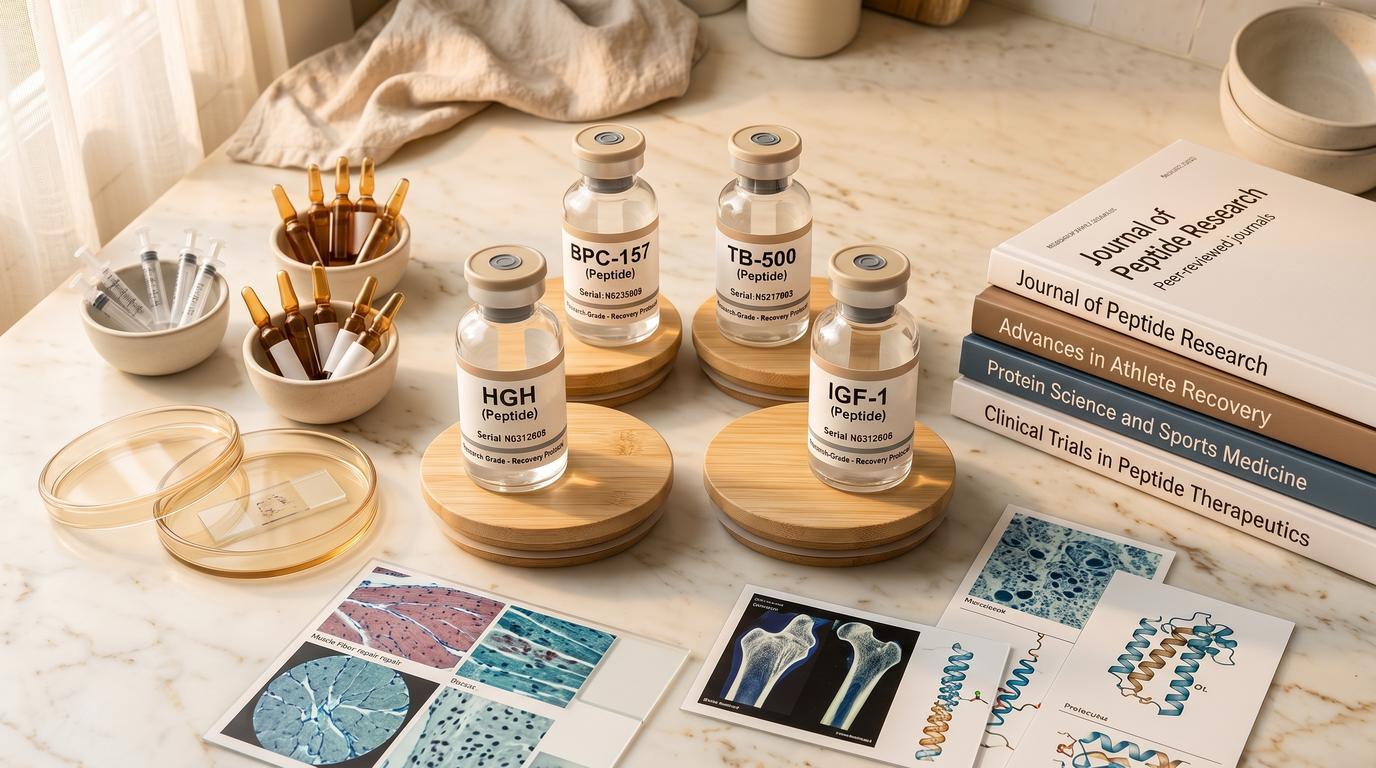
Peptide Therapy for Athletes: Recovery, Performance, and What the Research Shows

TB-500 (Thymosin Beta-4): What the Research Says About Tissue Repair