GLP-1 Medications Before Surgery: What You Need to Know
If you take semaglutide or tirzepatide and a surgery is on your calendar, there is something your surgical team needs to know. These medications change how quickly your stomach empties, and that chang

In this article
If you take semaglutide or tirzepatide and a surgery is on your calendar, there is something your surgical team needs to know. These medications change how quickly your stomach empties, and that change creates a real, documented safety concern during anesthesia.
This is not a reason to panic. Millions of people on GLP-1 medications have surgery safely every year. But in the last two years, medical societies across anesthesiology, surgery, and gastroenterology have updated their guidance on how to manage these drugs before procedures. The recommendations are practical and easy to follow. What matters is acting on them before your procedure, not the morning of.
*Compounded semaglutide and compounded tirzepatide are not FDA-approved medications. This article is for informational purposes only and does not constitute medical advice. Always consult your licensed healthcare provider and your surgical/anesthesia team before stopping or adjusting any medication.*
---
The Problem That Caught Surgeons Off Guard
Standard preoperative fasting instructions have worked well for decades. In most cases, nothing by mouth for six to eight hours before a procedure is enough to clear solid food from the stomach and reduce aspiration risk during anesthesia.
The problem is that those guidelines were written before GLP-1 receptor agonists became widely prescribed. Semaglutide and tirzepatide work partly by slowing how quickly food moves from the stomach into the small intestine. That slowing is intentional - it contributes to the appetite suppression and blood sugar regulation that make these medications effective.
During anesthesia, the airway loses its normal protective reflexes. If stomach contents are aspirated into the lungs during a procedure, the consequences can be serious, including aspiration pneumonia. Standard fasting reduces that risk because the stomach is expected to be empty.
In patients on GLP-1 medications, that assumption can be wrong.
A case report published in *Cureus* in 2023 documented a 31-year-old patient who had fasted appropriately for more than 10 hours before a scheduled endoscopy. Despite the extended fast, when the procedure began, significant food was still present in the stomach. The procedure had to be cancelled (Fujino et al., 2023; PMID: 37602101). When the patient returned one month later, after seven days off semaglutide and 36 hours on a liquid diet, the stomach was clear.
That case, and others like it, prompted anesthesiologists to take a closer look at what GLP-1 medications were doing to their patients.
---
Why GLP-1 Drugs Slow Gastric Emptying
GLP-1 receptors are found throughout the gut. When activated by semaglutide or tirzepatide, they reduce the movement of food out of the stomach by decreasing antral contractions and increasing the tone at the pylorus (the valve between the stomach and small intestine).
In most clinical contexts, this is a feature. Food that lingers in the stomach produces satiety signals for longer, which reduces hunger and overall food intake.
The flip side is that for procedures requiring general anesthesia or deep sedation, delayed emptying means the stomach may still contain food or liquid long after a standard fast would be expected to have cleared it.
A 2024 review published in *Cardiovascular Endocrinology & Metabolism* quantified this effect: in a systematic review of solid-phase gastric emptying studies, patients on GLP-1 receptor agonists showed approximately 36 minutes of additional delay in gastric emptying compared to controls, with 72 percent retention at two hours and 37 percent at four hours (Shankar et al., 2024; PMID: 39649679). For a medication taken once weekly with a half-life of approximately seven days, this effect does not disappear overnight.
---
What the Updated Guidelines Say
In October 2024, the American Society of Anesthesiologists (ASA), together with multiple specialty societies, released updated multi-society guidance on managing GLP-1 receptor agonists before surgery and procedures. The guidance takes a risk-stratified approach rather than a blanket rule.
For most elective procedures, the current recommendations are:
- Daily GLP-1 medications (oral semaglutide): Skip the dose on the day of the procedure.
- Weekly injectable medications (semaglutide, tirzepatide): Hold the dose for one full week before the procedure.
- Patients at elevated aspiration risk: Consider extending the hold, following a liquid diet before the procedure, or requesting gastric ultrasound assessment before proceeding.
For patients without these risk factors and without significant GI symptoms, the guidance indicates that continuing GLP-1 medications before low-risk procedures may be acceptable. The key phrase is: patients and providers should make this decision together, with the surgical and anesthesia team fully informed (Mishra et al., 2025; PMID: 40169221).
---
What to Tell Your Anesthesiologist
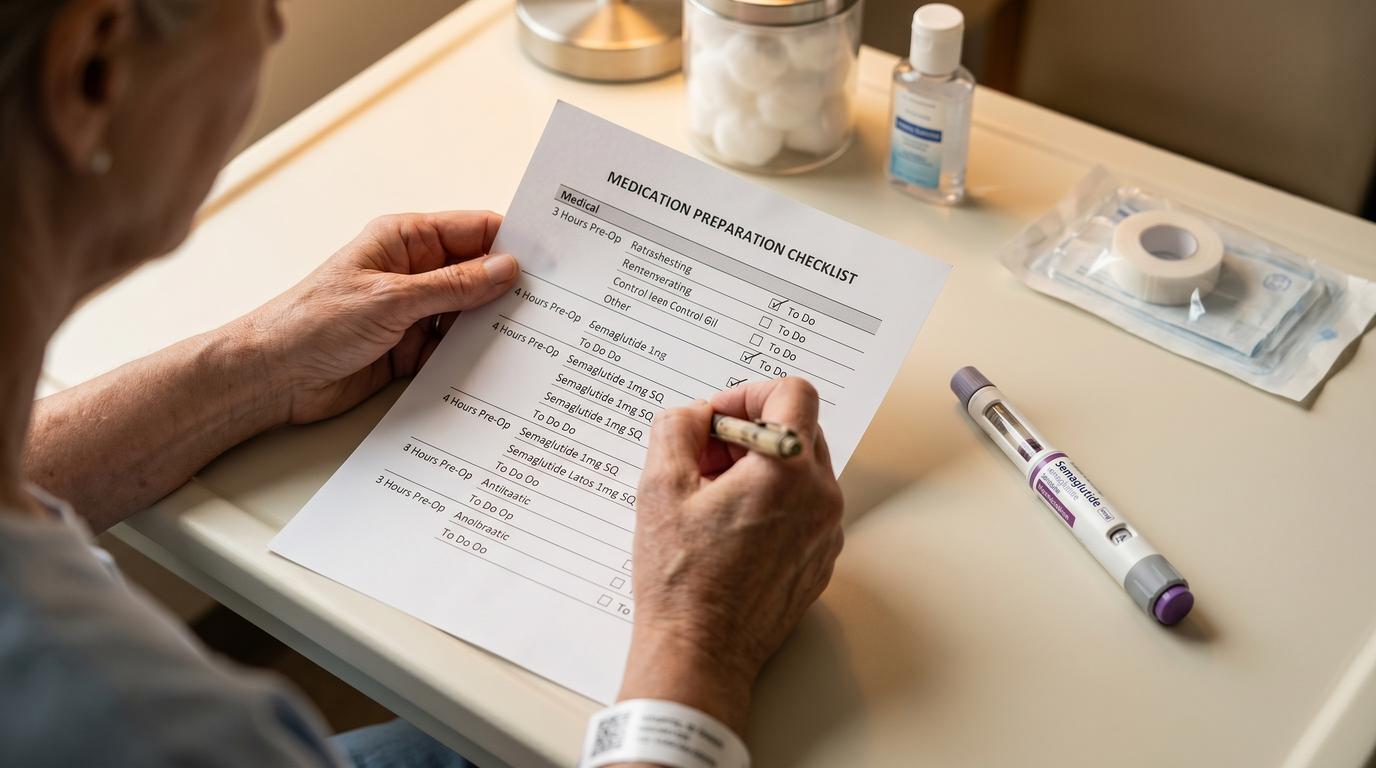
Your anesthesiologist needs to know you are on a GLP-1 medication before your procedure. This is not optional, and it is not embarrassing. It is the same category of information as telling them you take blood thinners or have sleep apnea.
When you speak with your anesthesia provider, be ready to share:
The medication name. Semaglutide and tirzepatide are the most common. Also mention whether it is compounded or a brand-name product, since that helps confirm the drug class.
Your dose and injection frequency. A patient on a stable maintenance dose of semaglutide 2.4mg weekly has a different risk profile from someone mid-escalation on their third week. This information matters.
Your last injection date. If your weekly injection was three days ago, your anesthesiologist will want to know that, especially for a procedure requiring deep sedation or general anesthesia.
Any gastrointestinal symptoms. Nausea, vomiting, constipation, or early fullness in the week leading up to your procedure are signals that gastric emptying may be more significantly delayed. Report them honestly.
A 2023 paper published in *Plastic and Reconstructive Surgery - Global Open* reviewing emerging anesthesia risks with semaglutide specifically recommended that preoperative assessment for all surgical patients now include direct screening for GLP-1 medication use (Fezza et al., 2023; PMID: 38025626).
---
The Gastric Ultrasound Option
One of the tools gaining traction for higher-risk patients is point-of-care gastric ultrasound. This is a bedside, non-invasive ultrasound assessment of the stomach contents performed shortly before a procedure begins.
A gastric ultrasound can confirm whether the stomach appears empty or still contains significant residual volume. If food or liquid is present, the anesthesia team has options: proceeding with a modified technique, extending the fast, or in some situations, rescheduling the procedure.
This technology is not universally available, and it is not necessary for every patient on a GLP-1 medication. But for patients in dose escalation, with GI symptoms, or with underlying gastroparesis, it is worth asking whether your facility offers it.
---
If You Cannot Pause Your Medication
For most patients with elective procedures, pausing a weekly GLP-1 injection for one week before surgery is manageable. But not every situation is elective, and some patients have clinical reasons why their care team may not want them off the medication.
In these situations, there are strategies that can reduce aspiration risk:
Liquid diet for 24 to 36 hours before the procedure. This does not eliminate delayed gastric emptying, but liquids move through the stomach faster than solids. In the documented case of the patient whose procedure was initially cancelled, switching to a liquid diet for 36 hours before the rescheduled endoscopy allowed the procedure to proceed safely.
Extended NPO (nothing by mouth) instructions. Your anesthesia team may extend the standard fasting window beyond the usual six to eight hours. Exact timing depends on your individual medication, dose, and clinical context.
Modified anesthesia technique. Anesthesiologists have options for managing patients with higher aspiration risk, including rapid sequence induction, a technique that sequences the medication and airway management to minimize the window of vulnerability. This is a clinical decision made by your anesthesiologist based on your specific situation.
The important thing is not to make this decision on your own. If you are worried about stopping your GLP-1 medication before surgery, that is a conversation to have with your provider and your surgical team - not a reason to hide the medication.
---
Endoscopy and Colonoscopy: A Different Set of Rules
Patients often ask whether the same guidance applies to endoscopy and colonoscopy, since these are common outpatient procedures with sedation.
The short answer: it depends on whether you have GI symptoms.
For colonoscopy, the standard bowel prep clears the colon as a matter of course, and the sedation used is often lighter than general anesthesia. For most patients without active GI symptoms on stable GLP-1 doses, continuing the medication and proceeding with the standard prep is generally considered acceptable.
For upper endoscopy (EGD), the stomach is directly in scope, and gastric emptying is more relevant. The case described earlier in this article involved an upper endoscopy. If you have active nausea, vomiting, or reflux symptoms, your endoscopist should know you are on a GLP-1 medication before proceeding.
---
A Practical Pre-Surgery Checklist
Before any procedure requiring sedation or general anesthesia, take these steps:
- Tell your surgeon. Mention your GLP-1 medication at every preoperative appointment.
- Tell your anesthesia provider. Even if your surgeon knows, do not assume the information has been passed along. Say it again at the preoperative anesthesia visit.
- Ask directly about the medication pause plan. What dose and timing applies to your medication? When should you hold it?
- Follow a low-residue or liquid diet if recommended. Your surgical team may advise dietary changes in the days before your procedure.
- Report any GI symptoms before the procedure. Nausea or vomiting in the week before surgery changes the risk calculation.
- Do not restart your medication until cleared by your provider. After surgery, get explicit guidance from your care team about when to resume.
What This Means for Your Weight Management
For most patients, pausing a weekly GLP-1 injection for one week before surgery does not undo months of progress. These medications have long half-lives, and the metabolic effects do not disappear in seven days.
After surgery, once your care team has cleared you to resume, you can pick up where you left off - typically at the dose you were taking before the procedure, with guidance from your provider on timing.
The goal of these guidelines is to protect you during a brief vulnerable window, not to take away a treatment that is working for you.
---
Questions to Bring to Your Pre-Surgery Appointment
- I take [semaglutide/tirzepatide]. When should I hold my last dose before this procedure?
- Are you recommending a liquid diet before surgery, and if so, for how many hours?
- Is gastric ultrasound available at your facility?
- Do I need to extend my fasting window beyond the standard instructions?
- When can I safely restart my injection after surgery?
---
The Bottom Line
GLP-1 medications are effective and widely used. They also affect gastric motility in ways that matter when you are going under anesthesia. The updated guidance from major medical societies is clear: disclose your medication, follow a coordinated pause plan based on your dose and frequency, and work with your entire surgical team before the procedure.
This is not a barrier to having surgery. It is a straightforward step in making surgery safer.
Ready to explore your treatment options or discuss your current GLP-1 program? [Check your eligibility with Prescriva](/start) to connect with a licensed provider who can coordinate your care, including perioperative guidance.
---
Sources
- Fujino E, Cobb KW, Schoenherr J, Gouker L, Lund E. Anesthesia Considerations for a Patient on Semaglutide and Delayed Gastric Emptying. *Cureus.* 2023;15(7):e42153. PMID: 37602101. doi:10.7759/cureus.42153
- Fezza R, Rains B, Fezza T, Fezza JP. Emerging Anesthesia Risks with Semaglutide. *Plast Reconstr Surg Glob Open.* 2023;11(11):e5427. PMID: 38025626. doi:10.1097/GOX.0000000000005427
- Shankar A, Sharma A, Vinas A, Chilton RJ. GLP-1 receptor agonists and delayed gastric emptying: implications for invasive cardiac interventions and surgery. *Cardiovascular Endocrinology & Metabolism.* 2024;14(1):e00321. PMID: 39649679. doi:10.1097/XCE.0000000000000321
- Mishra S, Persons PA, Bersoux S. Should glucagon-like peptide 1 receptor agonists be withheld during the preoperative period? *Cleveland Clinic Journal of Medicine.* 2025;92(4):209-211. PMID: 40169221. doi:10.3949/ccjm.92a.24110
- American Society of Anesthesiologists. Multisociety Guidance on Perioperative Management of GLP-1 Receptor Agonists. October 2024. Available at: asahq.org.
Medical Disclaimer: This article is for informational purposes only and does not constitute medical advice. Consult a licensed healthcare provider before starting, stopping, or adjusting any medication.
Compounding Disclaimer: Compounded semaglutide and compounded tirzepatide are not FDA-approved medications. Compounded drugs are not reviewed by the FDA for safety, efficacy, or quality. Compounded semaglutide is not the same as, equivalent to, or interchangeable with FDA-approved semaglutide products (Ozempic, Wegovy, or Rybelsus). Compounded tirzepatide is not the same as, equivalent to, or interchangeable with Mounjaro or Zepbound.
Results Disclaimer: Individual results vary. Weight management outcomes depend on adherence to your prescribed treatment plan, diet, exercise, starting weight, and other individual health factors. Results are not guaranteed.
Provider Disclaimer: All medical services, including prescribing, are provided by independently licensed healthcare providers. Prescriva LLC, doing business as Prescriva is a management services organization and does not practice medicine or make clinical decisions.
Brand Disclaimer: Ozempic, Wegovy, and Rybelsus are registered trademarks of Novo Nordisk A/S. Mounjaro and Zepbound are registered trademarks of Eli Lilly and Company. Prescriva is not affiliated with, endorsed by, or sponsored by these companies.
Stay informed
Weekly research updates and health guides. No spam.
References
- Fujino E, Cobb KW, Schoenherr J, Gouker L, Lund E. Anesthesia Considerations for a Patient on Semaglutide and Delayed Gastric Emptying. Cureus. (2023).
- Fezza R, Rains B, Fezza T, Fezza JP. Emerging Anesthesia Risks with Semaglutide. Plast Reconstr Surg Glob Open. (2023).
- Shankar A, Sharma A, Vinas A, Chilton RJ. GLP-1 receptor agonists and delayed gastric emptying: implications for invasive cardiac interventions and surgery. Cardiovascular Endocrinology & Metabolism. (2024).
- Mishra S, Persons PA, Bersoux S. Should glucagon-like peptide 1 receptor agonists be withheld during the preoperative period? *Cleveland Clinic Journal of Medicine.* 2025;92(4):209-211. PMID: 40169221. doi:10.3949/ccjm.92a.24110. Published Research (2025).
- American Society of Anesthesiologists. Multisociety Guidance on Perioperative Management of GLP-1 Receptor Agonists. October 2024. Available at: asahq.org.. Published Research (2024).
Ready to get started?
Check if you qualify for a personalized treatment plan.
Check Your Eligibility →