Compounded Semaglutide Shelf Life and Expiration: What Patients Need to Know
Compounded semaglutide expiration works differently from brand-name medications, and understanding the distinction can directly protect your safety and treatment outcomes.
In this article
Compounded semaglutide expiration works differently from brand-name medications, and understanding the distinction can directly protect your safety and treatment outcomes.
*Compounded semaglutide is not FDA-approved. This article is for informational and educational purposes only and does not constitute medical advice. Always follow the storage and handling instructions provided by your compounding pharmacy and licensed healthcare provider. Beyond-use dates for compounded medications vary by formulation and pharmacy; figures in this article are general references only.*
---
If you receive compounded semaglutide as a multi-dose vial, you have probably noticed a label that gives a beyond-use date (BUD) rather than a traditional manufacturer expiration date. These are not the same thing, and the distinction matters.
Manufacturer expiration dates on brand-name drugs like Ozempic and Wegovy reflect stability testing conducted under controlled, FDA-regulated manufacturing conditions. Beyond-use dates on compounded medications are assigned by the compounding pharmacy based on its own formulation testing and applicable pharmacy standards, primarily USP Chapter \<797\> for sterile preparations. Both serve the same purpose but arrive at their conclusions through different processes.
This guide covers how compounded semaglutide shelf life is determined, what affects it, how to recognize deteriorated medication, and what to do if your vial has passed its BUD.
---
How Long Does Compounded Semaglutide Last?
Compounded semaglutide stored refrigerated at 36°F to 46°F (2°C to 8°C) typically carries a beyond-use date of 90 to 180 days from the date of compounding. Some pharmacies assign shorter windows based on formulation variables, including the excipients used, the vial volume, and whether the medication was prepared as a single-use or multi-dose container.
That range is general context, not a universal guarantee. Your pharmacy's label is the authoritative reference for your specific formulation. Compounding pharmacies that work with telehealth platforms vary in their BUD policies, and no single federal standard sets one shelf life number for all compounded semaglutide preparations.
For comparison, brand-name semaglutide products have the following shelf life windows:
| Product | Sealed (Refrigerated) | After First Use |
|---|---|---|
| Ozempic | Up to labeled expiration date (typically ~2 years from manufacture) | 56 days at room temp below 77°F/25°C or refrigerated |
| Wegovy | Up to labeled expiration date | 28 days at room temp below 77°F/25°C or refrigerated |
| Compounded semaglutide | Per pharmacy BUD label (typically 90–180 days refrigerated) | Varies; follow your pharmacy's written instructions |
---
What Affects Compounded Semaglutide Stability?
Semaglutide is a 31-amino acid peptide. Its molecular precision is part of what makes it effective, and it is also why it requires careful handling. Research on semaglutide preformulation stability demonstrates that temperature and pH are the primary drivers of degradation in solution, with higher temperatures and suboptimal pH accelerating deamidation, oxidation, and aggregation pathways. (PMID: 40490042) Separately, thermally stressed solid-state stability studies confirm that even in non-liquid formulations, elevated temperature produces measurable changes in protein content and secondary structure. (PMID: 42086873)
Several practical variables affect how long your compounded semaglutide remains stable:
Formulation type. Most patients receive aqueous solutions (liquid vials). Some pharmacies also compound lyophilized (freeze-dried) preparations intended to be reconstituted before use. Lyophilized forms can support longer pre-reconstitution storage windows; once reconstituted, the same stability considerations apply as with aqueous solutions.
Preservatives. Multi-dose compounded vials typically contain benzyl alcohol as an antimicrobial preservative. The type and concentration of preservative is one variable pharmacies consider when assigning a BUD.
Temperature. Refrigeration at 2°C to 8°C is required for maintaining stability. Brief excursions above this range accelerate degradation. Many pharmacies allow a defined room-temperature window after first use, often up to 28 days at temperatures below 77°F (25°C). That window is shorter than the refrigerated BUD for a reason: degradation proceeds faster at ambient temperature.
Light exposure. Semaglutide is susceptible to photodegradation. Keep vials in their original box or an opaque sleeve when not in use, and avoid drawing doses in bright direct light.
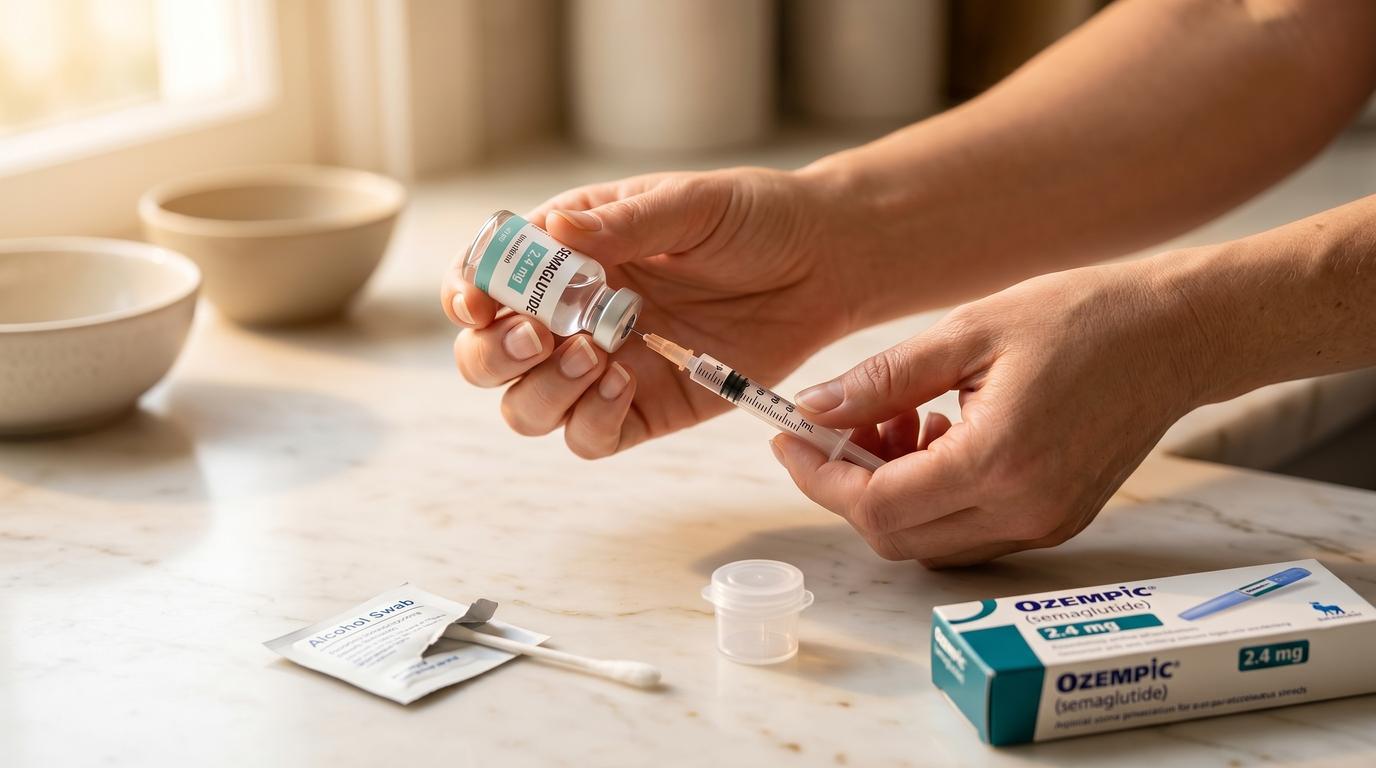
Multi-dose handling. Each needle insertion into a multi-dose vial introduces a small contamination risk, even with proper technique. Good aseptic practice (clean hands, alcohol-swabbed stopper, sterile syringes) helps the preservative system do its job and supports the stability assumptions built into the BUD.
---
How 503A Pharmacies Establish Beyond-Use Dates
Compounded semaglutide is an injectable medication, which means it falls under sterile compounding requirements, specifically USP Chapter \<797\>. Pharmacies operating under USP \<797\> must meet standards for sterile preparation environments, quality control, and beyond-use dating.
Pharmacies with PCAB (Pharmacy Compounding Accreditation Board) accreditation have undergone third-party audit confirming their compliance with these standards. PCAB accreditation is a meaningful signal when evaluating a pharmacy partner for your telehealth provider.
When establishing a BUD, a compounding pharmacy can take one of two approaches. The first is to adopt conservative default BUDs defined in the applicable USP standard, which do not require independent testing but may produce shorter windows. The second is to conduct formulation-specific stability testing (using methods such as HPLC or LC-HRMS assay to measure potency retention over time) to support a longer, evidence-backed BUD. The second approach is more resource-intensive and is typically a marker of more sophisticated pharmacy operations.
If you are evaluating telehealth providers, it is reasonable to ask which pharmacy compounds your medication, whether that pharmacy is 503A-accredited, and whether a Certificate of Analysis is available for your batch. A provider with a credible pharmacy relationship will have clear answers to all three. See also our guide on [how to evaluate a compounded GLP-1 provider and 503A pharmacy](/articles/how-to-evaluate-compounded-glp1-provider-503a-pharmacy).
---
---
Signs That Compounded Semaglutide Has Deteriorated
Before every injection, inspect your vial in good lighting. This is a required step, not optional. The solution should be:
- Clear to colorless, or very slightly pale yellow
- Completely free of floating particles, sediment, or cloudiness
- Consistent in appearance compared to when you first opened the vial
- The solution has changed color (brown, pink, or orange tones signal chemical changes)
- You see floating particles, sediment, or haziness
- The solution appears foamy or contains visible aggregates
If you notice what seems like reduced efficacy, and the timing aligns with an extended storage window or temperature excursion, that warrants a conversation with your provider. The distinction between a pharmacological plateau from metabolic adaptation and genuine dose instability is clinically relevant, and your care team can help you sort it out.
---
What to Do If Your Semaglutide Has Expired
Do not inject compounded semaglutide that has reached or passed its beyond-use date. Expired injectable medications carry two distinct risks: reduced or absent potency (meaning the dose no longer delivers the expected active drug), and possible degradation products that could trigger injection-site reactions.
If your vial has expired or you are unsure whether it is still within its BUD:
- Stop drawing doses from it. Set the vial aside immediately.
- Contact your telehealth provider or compounding pharmacy. Most providers have a process for replacing expired medication within your treatment window. Do not wait for your next scheduled check-in; reach out promptly.
- Dispose of it properly. Liquid medication should not go down the drain or into household trash. Mix it with an undesirable substance (coffee grounds, cat litter) sealed in a bag for trash disposal, or use a community medication take-back program. The syringe and needle you used are sharps waste and must go into an FDA-cleared sharps container, not loose in the trash.
Branded vs. Compounded Semaglutide: Key Shelf Life Differences
The most important difference is not duration but process. Brand-name Ozempic and Wegovy carry expiration dates backed by years of manufacturer stability data submitted to the FDA as part of the drug approval process. Compounded semaglutide carries a BUD determined by the compounding pharmacy under USP \<797\> requirements.
Both frameworks can produce stable, potent medication. The practical implication for patients is that compounded formulations require slightly more engagement: check the label when your vial arrives, note the BUD, track how long you have had it, and store it correctly from day one. The [semaglutide storage guide](/articles/how-to-store-semaglutide) covers temperature requirements, refrigerator placement, and travel considerations in detail.
For a broader discussion of safety and quality controls, see [is compounded semaglutide safe?](/articles/is-compounded-semaglutide-safe) and [what is compounded semaglutide?](/articles/compounded-semaglutide-what-it-is).
---
*This article is intended for informational and educational purposes only and does not constitute medical advice. Consult your healthcare provider and dispensing pharmacy before making any decisions about your medication.*
---
References
- Effect of pH, buffers, molarity, and temperature on solution state degradation of semaglutide using LC-HRMS: A preformulation stability study. *European Journal of Pharmaceutics and Biopharmaceutics*. 2025. PMID: 40490042
- Thermally Stressed Solid-State Stability of Semaglutide: Understanding the Influence of Temperature on Protein Content, Secondary Structure, and Physical Properties. *Pharmaceutical Research*. 2026. PMID: 42086873
- United States Pharmacopeia (USP) Chapter \<797\>: Pharmaceutical Compounding — Sterile Preparations. Current edition.
- Ozempic (semaglutide) Prescribing Information. Novo Nordisk. Current US labeling.
- Wegovy (semaglutide) Prescribing Information. Novo Nordisk. Current US labeling.
Stay informed
Weekly research updates and health guides. No spam.
References
- Effect of pH, buffers, molarity, and temperature on solution state degradation of semaglutide using LC-HRMS: A preformulation stability study. European Journal of Pharmaceutics and Biopharmaceutics (2025).
- Thermally Stressed Solid-State Stability of Semaglutide: Understanding the Influence of Temperature on Protein Content, Secondary Structure, and Physical Properties. Pharmaceutical Research (2026).
- United States Pharmacopeia (USP) Chapter \<797\>: Pharmaceutical Compounding — Sterile Preparations. Current edition.. Published Research (2024).
- Ozempic (semaglutide) Prescribing Information. Novo Nordisk. Current US labeling.. Published Research (2024).
- Wegovy (semaglutide) Prescribing Information. Novo Nordisk. Current US labeling.. Published Research (2024).
Ready to get started?
Check if you qualify for a personalized treatment plan.
Check Your Eligibility →Continue reading

Does Medicare Cover GLP-1 Medications? Semaglutide, Tirzepatide, and Your 2026 Options

GLP-1 Medications and Chronic Fatigue Syndrome (ME/CFS): What the Research Shows